By Vannie Gama.
This year, SAR – Home | International Forum on Artistic Research theme was “Endangered Conceptual World”. If there is something we have been through, it is the immense oppressive force and action against more than conceptual worlds, but also against the main body that carries, shares, and nurtures such conceptual worlds. It is not a shift in culture but the engendering of existences. It was the first time I had a research project that would fit the Zeitgeist of such troubled times already completed. Usually, what happens—and what is also extremely important for the research itself—is to take part in congresses, conferences, forums, etc., with an ongoing research. This time, seeing the beginning of a research and its maturity, and seeing how the world is “after it,” felt like a time machine into a dystopian world. The year was 2022 when this started, and although things were evidently showing signs of what would and will come, it was a completely different ground to be and to work in social sciences, arts, culture, politics, etc.
But I do not want to use today’s letter/post to act as one more voice in the echo chamber of “yes, we are where we are, and the conditions are awful, and they will likely get worse until they get better,” because this is happening precisely because the ground of “earlier better times” was not solid enough to promote a shift toward well‑received diversity in the first place. And so on. The arguments are similar to those of climate change: it is visible, alright, so what now? Arguably, AI fits the same category of global issues neglected by different layers of the social sphere, but it would fit within a slightly different temporality. I would argue that AI issues are similar to the precedents that gave form to Kyoto’s treaty—precisely considering what happened afterwards, that is, the other problems we did not solve in the 2020s of the twenty‑first century, but for which Kyoto was a milestone in international relations and, moreover, cultural engagement.
Researchers and artists, activists and politicians, and people online are some of the pivots for change on the macroscale of things. On the microscale, where change actually happens—although usually underestimated—difference is slow but profound when we act in our daily lives to promote any cultural shift. This applies to endangered conceptual worlds, ecological worlds, and AI as well, although this last one might be a little more complex.
That said, I will not dedicate this post to manifestos, but to the specific reality of taking part in this year’s conference, the first one I have attended, and the first year I am a member of the Society of Artistic Research. All the formalities are well laid out on LinkedIn and other places dedicated to more demure, humble, and elegant mentions of the event.
It was my first trip to Ireland. As a Brazilian, Ireland is not at all an unknown destination; in fact, it is easier to find someone who has visited Ireland than Argentina, our neighbor. I talked about this with some of my friends—also artists and researchers—and we began debating why Brazilians travel so much to Ireland and how this started in the first place. This will sound quite pathetic, but I always avoided major cultural trends just enough for the fever hypes to pass through everyone. Maybe because of that, I never actually considered visiting Ireland. But life is as it is; it is not because I never felt compelled to go to Dublin that Ireland was not the most important country in my literary habits. James Joyce changed my life, Yeats changed my life, Beckett as well. Wilde is good, but nothing like those two. The world is as it is, but Irish, Brazilian, and Russian literature, for me, hold the best writing—with honorable mentions to Colombian, Japanese, and Indian literature. It is not a competition, and this opinion will likely change in the future, just as philosophy and music have their great homes, where the air is a fine whimsical whistle that draws you to earth like nothing else and no one else.
Arriving in Dublin in the same week as the Pride Parade, the airport was filled with rainbows and queer people everywhere. I felt instantly at home. And look, times are turbulent, the community is fragmented, but my position is that we must keep it loud and proud. There is no such thing as “pure” anything or a “clean way” of doing things. We need to embrace the imperfection of systems if we ever want to bring them down, and the anxiety of projecting what “would need to be done” often romanticizes the real ways available to us and, most importantly, endangers the reality of the living. Sure, Pride parades are part of capitalism; sure, politicians will use them in their favor. We still need to pay our bills, sell our artworks, books, intellect, and know‑how to the very same world. Politics is the social contract, and we have bigger problems than the “ideal reasons” for having rainbows. Right now, we are losing space and losing our breath. I was deeply content to see that. Here in Montréal, Pride was silent. A few days on some streets, one or another ad. We live in a world of attention and information; if no ads feature our faces, we are simply excluded from the raw dynamics of visibility. And before the idealism of “oh, but it is better not to be part of that” floods some people’s minds, remember that legitimacy does not see systems; the legitimacy of humanity sees social space.
Due to being short on money, I stayed in a hostel both in Dublin and in Galway. I met a writer in Galway who was traveling on vacation after finishing a novel. We spent our breakfasts talking about creative processes, arts, and the elephant in the room: the rise of fascisms in their many forms. He also worked in an environmental organization, so we had plenty to discuss while sharing our simple and great breakfast.
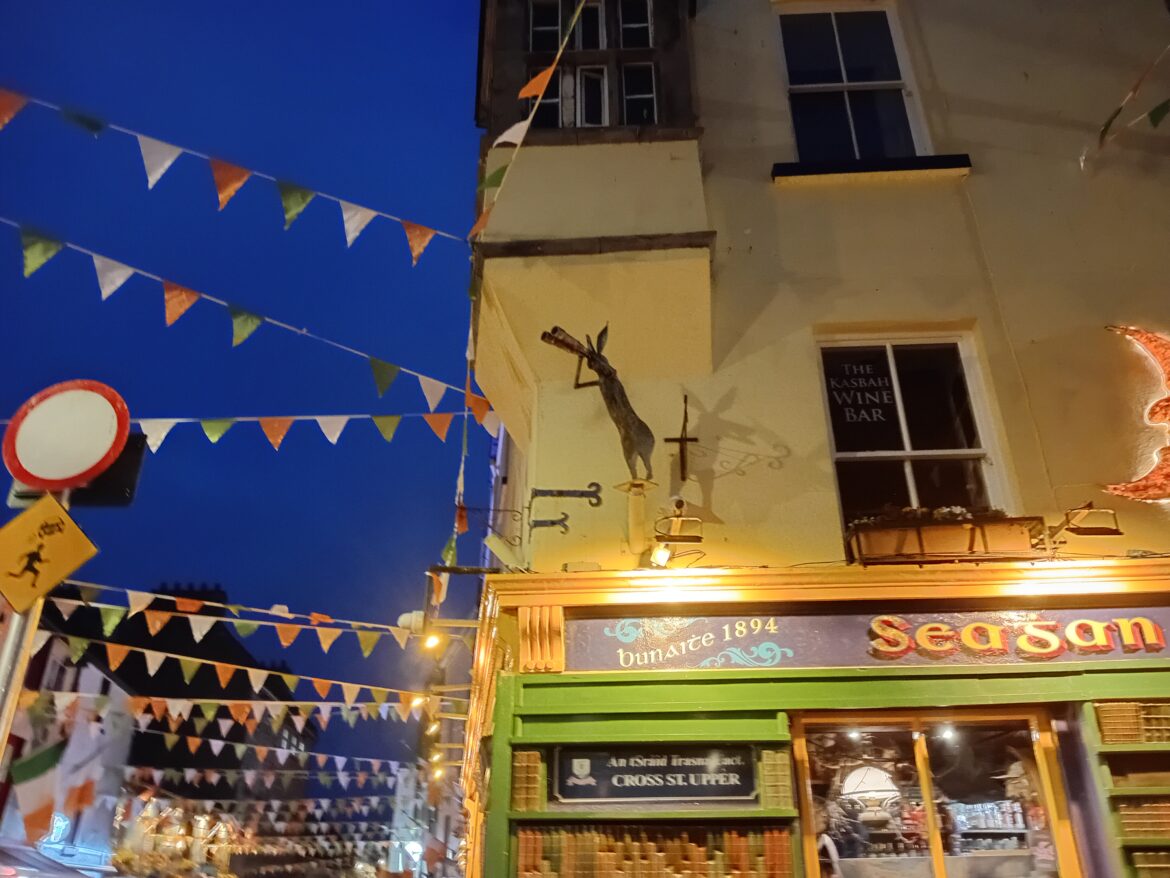
Dublin made me feel oppressed, as family sometimes does. Too many tourists like me, too much of everything. That was during the first few hours, until the bus to Galway arrived. Galway was a completely different story. If Dublin felt like a dinner with all the family members you do not even remember the names of—because they are the siblings of the siblings of the siblings of that uncle you saw once in your life—Galway felt like returning home, chez moi, chez nous. There was something about it that made me spend almost every hour possible walking around, talking to people, learning about the problems and tensions between Irish and English, between new and old generations, the “real meaning” of a rock charm or a clover, the rituals for those days of solstice.
Regarding the congress itself, we had, as you can check on the website, more options per hour than what was humanly possible to attend. I met incredible artists and researchers, not only from the round table (Articulating Artistic Research: Language and Poetics) with Sára Gottsneivová, Janaina Carrer, Evangelia Katsaiti, and Joseph Steele, but also people such as Gwen Rakotovao, Costanza Julia Bani, Suzanne Knip-Mooij, and the organizer Florian Schneider. With some of these people, like Sára and Gwen, it was more than appreciating their research and languages; it was being able to live the imperfections, the tensions, the resiliences, and the contexts that we still need to be aware of and change in the poles of Artistic Research, through our discussions and also actions, the semiotic intentions imprinted in performances. Humanhood.
And I met Erin Hill. Alright, this was something else — she did a workshop called “Sunrise Commitment.” For this, we had to wake up around 4 a.m. It started at 4:25 a.m. and went well past 6 a.m. We enjoyed a cold beach bath in the early morning. Not many of us, but more than eight showed up to write on that unique beach bay of Galway. After that experience, she handed us a copy of her book. She is also from Montréal, and her mother was also born on April 17, the date on which the book begins. I read her book in three days, starting on my flight back home. Inspired by her, I also started a commitment. I will not publish it, and the focus is more on mind than body, mixing elements of what is important to me and, as with her, a way to see time and change differently. My commitments are the Moonset and Moonrise, but since they change drastically every day, what I do is watch the sky daily and note the stars, the constellations, the hour… and maybe, similar to her, embrace the days when I cannot do it for one reason or another. Maybe it is raining, maybe my freelance work calls me and I have to look at the sky while walking to the bus station. What matters is to write. It started on June 29. Two months now. August 29 was also when I completed one year living in Canada. Thank you, Erin. Our talks and your book were milestones. The scene of everyone running to the sea in that crystal emerald blue, super cold water, surrounded by those lots of burnt sienna algae, brings me tranquility and inspiration. Simple as that. Horses, flocks, my LGBT Pride flag on the sand so some could sit and finish the great blueberries.
At the event, I had a brief opportunity to talk about my project, “Ai mone! Dimensions of Pop Queer in Brazil through Drag Queen Art, Pajuba and the embodiment of DIY.” It is, as always, a long name. Pop Queer changed a lot since I started theorizing it back in 2022. I had to do an entire review of it in terms of dynamics for the 2026 presentation. Soon, I will share with you the article resulting from this particular frame, where unfortunately Drag Queen Art and the history of Pajuba are more a symbol of resistance in the ruins of the right to perform in the Americas than an example of these new times of visibility for Drag Queen art and language. Visibility is not always a positive word; on the contrary, it can endanger one’s space. But in the first scenario of 2022, it was more in the sense of the visibility of the opacity, the solid and tall trees of this form of art in pop culture — and a twist in pop culture compared with its roots in the 80s. Right now, visibility means a target in the forced transparency of one’s body; it is turning into paper and watering down or burning it. So here we are, protecting all forests again.
I cannot wait to visit Galway again, and you will see a lot of artworks referencing that event. And for the next conference, already confirmed to be in Bratislava, 2027.
Share this:

Would you like to receive the next post on your digital door?