By Vannie Gama
Now my Patreon page is up! To share it, there is this line and a few paragraphs at the end of this text; otherwise, it was an action that motivated me to write this short essay. I dedicate this critical essay to all my art collectors who make it possible for me to begin writing that fourth book and, most importantly, to enter a new series of paintings, installations, and drawings, which is Astropoetics (2025–2026).
The art world is the very image of “Saturn devouring his son” (from Goya, in the 1820s; out of curiosity, it was created in the same years as the independence of Brazil and Peru and a little after the independence of Argentina and Chile [1820]. 1820 was also the year in which the famous Venus de Milo was found on the island of Milo). I begin with these points because the dynamics of art are, like every human experience, largely defined by the temporal, political, and cultural frame through which we look; however, art is also this vast superimposition of events, territories, and political convergences of contemporarity.
Statements and popular archetypes: the poor artist, the discovered artist, fame after death, are three observations that are caricatures. There is a great divergence between the art world inhabited by artists and the structure that disseminates, promotes, preserves, and “historicizes” (beyond documenting, we are speaking of the telling of stories) art and these popular sayings, which place the artist at the center of their own creation. In practice, this has rarely existed. The artist is subordinated to the will of the upper chains of the artistic hierarchy, and sells their craft to this other; in the absence of this relationship, there is indeed poverty, hunger, the abandonment of one’s own life, and any narrative that attempts to romanticize the artist’s reality historically acts in bad faith and with poor research, by failing to consider the social class to which the artist belongs before any rooting in the art world itself. We could already enter the question of art as entrepreneurship, a very contemporary language rooted in the twenty-first century, but let us take a step back and observe the problem of the practical scale of the Saturnian world of the arts.
It is curious that, popularly, there exists a relation, often parasocial, with the artist’s performance, especially in the visual arts. Each century, and within each century each set of decades, preserves some hierarchy in which the artist is not the last to have any say: it is not the artist who speaks about their own art, it is not they who present themselves to a given audience; the person is chosen to assume this performative market role through a relation close to any profession: being in the right place at the right time, contacts can and will help you, and evidently, skill with the work and accumulated experience will facilitate artistic stability. Perhaps my favorite example of this is that Leonardo da Vinci began taking commissions because his father helped him find buyers; over time da Vinci kept “scaling” these contacts, but do not be mistaken in thinking that everything he did was “on his own.” There’s no such thing in the history of art, and when there is, the common ending is not the most beautiful, and if it is, well, it will become another icon.
There is no problem at all with the lack of autonomy – let us complicate and stretch the gradient in the use of the word autonomy, because it is not interchangeable with freedom. The myth of it, in fact, is quite harmful to the artist and their work. The problem is that most of what you will read about the art market historically does not give space to the artist’s voice in any real sense: perhaps a few interviews in contemporary art and for modern icons, or in one of the only “untouchable” moments of this supposed autonomy, which is the vernissage or exhibition openings in general. And it is not for lack of willingness on the part of artists: there were dozens of letters and diaries simply disregarded throughout the history of art.
Today, in contemporary art, we have much more space to speak about our work than we ever had: partly because of the information age, partly because of the turn of contemporary pop as a whole, and these things have contributed to the fact that today it is increasingly common to see the return of artists who write about their works, collectives that actively participate in the promotion of their exhibitions through workshops or even through part of the guided visits together with professional mediators. This honeymoon of artist–work communication is quite authentic and fundamental to what art is in our time, something inherited from the community art of the 1980s. Until then, that suffocating structure that placed the artist on their knees before large galleries and dealers at the height of modern art had been perhaps the complete opposite of art today. Not all artists have the space of agency over their own creation, but it is certainly much more common and less hierarchical, although there are slightly embarrassing modern traditionalities in which artists try to perform a bird dance to the maximum in order to be approved in so‑called “rigid” (retrograde) selections.
In my experience, most good galleries, institutions, awards, and structures that will enter into any contract with the artist are gently horizontalized and clearly concerned with the good communication of the works, with rigor and not rigidity (there is even an etymological difference between the words, one focused on a solid foundation, and the other inflexible to change). It is, however, difficult to reach this place where the art world welcomes the artist in community: it is a collective task, fundamentally, to attribute value (cultural value, above all) to art; each part has an essential role, and when I prioritize the artist’s voice here, it does not mean that this work is autonomous and individual, but rather that there is ethics and respect for the integrity of the artist and the creation throughout the entire process of artistic dissemination, avoiding hierarchies that silence the person and the piece in favor of new narratives imposed by any external diffuser. The joint work between artist and institution, public or private, results in authentic and well‑resolved projects that generally bring the public even closer, as they can easily recognize the truthfulness of the intention behind a given exhibition or catalogue.
As mentioned, the art world carries within its framework the social and political reality of a given society (or of the integration between several): in addition to public institutions or, in any case, institutions in the social‑organizational sense, art collectors and patrons, as well as demands for individual projects or commissions, are part of a greater personification and individuation within the diversity of the artistic world. Historically, this relationship between art collectors and/or patrons and artists is also heavily romanticized, yet it was in fact better than the meat‑grinding machine that does not mind leaving thousands of artists with crumbs of percentages over the added value of their creations. Great patrons in history were directors of museums and cultural institutions in the case of visual art, and for music, they were often people connected to the machinery of the state or to great fortunes that sponsored musical events; after all, these were never solitary art forms: every art consists of at least two problems, the first, the work, and the second, its dissemination or exhibition; whether in literature, in music, in the visual arts, and above all (as always) in cinema, cultural investment has a particular concern with the second.
There were different dynamics between patrons and the State over the centuries. The responsibility of maintaining the dynamism of the cultural sphere in a given society, considering its dimensions, changes its parameters throughout history and regulates its balance between the individual and the structure of the collective. Thus, whether in the era of patrons who owned large museums, of state commissions, or of simply bourgeois art buyers, artistic practice was possible, in materialization and in dissemination, above all through the encouragement of these parties; believe me, it is impossible for the artist to take full responsibility for the costs of their creation and its exhibition unless they take it from somewhere else, depending on the class and privileges surrounding them. Speaking of privileges, having art collectors around us is in itself such a privilege. Despite the various different names and the different weights and “statuses” of each external vehicle that enables the creation of art, the fact is that we need to eat, and creating is expensive, even in the worst possible way (for there is still the price of time, or the luxury value of a work not providing any real return, such as a roof, access to a minimum quality of life). Unfortunately, as we know, many artists neither had the privilege of being born wealthy nor of finding collectors or managing to work for the state or institutions during their lifetime, and it is a very simple equation: imagine a doctor working and not being paid, simply. What will happen? What happens to everyone who does not have a dignified income.
It deeply bothers me, this idea that art is something we do aside-of-a-whatever, as if a dentist could manage to have a part‑time job to sustain their clinic, or a psychologist, an architect, a public agent. Why, then, are we treated in such a way that demanding the minimum for the artistic class – some autonomy with ethics from the other functions of the cultural environment and the minimum integrity for the profession itself – is regarded as a luxury by other parts of society? Well, there are countries and cities with strong artists’ unions ( such as syndicates) that aim precisely to guarantee some quality of air for those who create, as well as cultural incentive laws, public policy mechanisms such as annual awards, events, or the seasonal passage over decades of a single institutional proposal (in various business models, public or private, or mixed) that regulate the tone of this human dignity within the art world (for the artist).
The artistic world is like Jupiter (the planet), too: gaseous, you cannot see a hand in front of your face if you are simply thrown there. It is somewhat deadly, even, depending on your conditions. However, these vehicles of diffusion and encouragement for the arts are indispensable, yet at the same time insufficient. The cultural sphere is not made only of elements “of power,” but of the very adhesion between different social classes to create the conductive amalgam for art to be art, for the artist to be effectively inserted into social dynamics, without exclusions interpolated into these insertions (which is the worst part of a system based exclusively on seasonal possibilities, without direct buyers, commissions, patrons, art collectors, etc.). One thing is to study the subject, another entirely is the experience among peers. For example, it is impossible for institutions alone to manage to ensure the survival of the artistic class, because the rotation of artists in these spaces (including in part of the galleries) is essential for the very health of artistic creation: the public thus encounters more artists and comes into contact with a diversity of projects coherent with the diversity of the social fabric itself.
In other words, there will always be far more artists applying for projects, open calls, awards, and exhibitions than the number that also ensures the quality of these events. Thus, it is in the more individual and personified forms of business rather than the corporate ones that artistic survival is in fact secured: direct sales, auctions, the projects we carry out in smaller numbers. This offers consistency for creation and is tied to the reality that artistic participation in exhibitions, festivals, and larger‑scale projects can then overlap with an existence independent of these events, made possible by incentives that are external to them. It is certainly a lot to manage. It is at this moment that many artists end up preferring parallel jobs and enter a battle to keep creation alive, even under poor conditions (especially for mental and physical health, given the high stress of balancing alternatives). Some manage this better, others not so much. Kafka, the author of “Metamorphosis”, spent decades balancing one job and another alongside his writing. In fact, he died at the age of 40.
Patrons are a specific category of those people who ensured the dignity and vigorous creation of almost all the artists we admire, whether writers, musicians, or visual artists. Not always great heirs, patrons could be, again, simply bourgeois or members of the middle class, who chose to support a particular person, and often the same artist would have several patrons throughout their life, with relationships lasting a few years, a decade, or in some cases, several consecutive decades. Support from people who were not necessarily from the elite is often left out of the history of major productions for culture and human knowledge, perpetuating the myth of the artist’s autonomy; a famous case may be that of Karl Marx, who, if not for his wife, daughter, and F. Engels, would not have written Das Kapital – for yes, financial help is one part, but a patron may also be involved in contacts, communication and dissemination, organization and translation of works, and any constant support to a given artist, including home duties, or, in a respectful manner, domestic work and labour.
Tchaikovsky, Debussy, many writers, all the famous painters (popular across the centuries, including in Art Pop) who were not born into families wealthy enough to help them sustain their careers, had financial or other forms of support in order to create, from individuals around them. These relationships were not only made of flowers and rainbows, for they were evidently never about charity, but rather about believing that a certain body of work was sufficiently relevant to be continued, and depending on the interpersonal dynamics and the historical context, these relationships could be conflictual or quite restrictive (or vigilant) regarding the work in development. Patrons are not angels, but like bursts of rain throughout the seasons.
Well, as these dynamics of sponsorship in the arts, whether under the now less‑valued name of “the one who commissions a work” or the broad umbrella of “art collector,” as well as those who are not necessarily seeking a final work but enabling an artist to continue creating, as in certain terms of the relationship between patron and artist, the fact is that these dynamics have once again been restructured and redimensioned in the information age, now in the twenty‑first century. First, as a reminder from the beginning of this text, all these considerations here are made from the perspective of artists before “any fame” or “popular consolidation”: so do not come to me with examples of success, because the approach here is precisely the reality of the before, not the after; creating roots that grip the earth is necessarily a process that comes after fragile germination, with thin and small roots, easily pulled out with no effort.
In the information age, media have changed once again, and the diffusion devices have allowed new dynamics, both in space and in the rhythm of consumption of art and culture, leading to a phase of even greater diversity in communication between artist and public (and between artist and the more traditional vehicles of diffusion of these works, or of sponsorship). As we are living through this phase, any diagnosis, even a superficial one like this text, becomes particularly unlikely to capture even minimally all the elements participating in these new dynamics. However, if there is something we can say, it is that quantity never refers to quality, and cultural obsolescence is an inevitable phenomenon in the present. Beyond this obsolescence – a low collective memory and an even lower retention of the quality or even the simple identity that a given activity / object / persona in culture has – hyperpalatability itself and intolerance toward the subjective, whether gradual or disruptive, join the equation of the formation of hyperprocessed “content,” appreciated by the public that “dictates the trends” – brief ones.
Almost like a paradox, although today the artist can promote their work “autonomously” with some ease compared to the dependence on exhibiting in salons, for example, and there meeting the public that would become one of the vehicles of that artistic proposal, they are also hostage to this dense flow of thousands of glitter particles that does not distinguish them and even forces them to respond to content restrictions in a form homologous to the restrictions of a traditional market, but with other rules: quantity and “consistency” in this production, sometimes weekly, for the online public, in addition to being forced, at least in the current fashion, to edit their content to make it enriched with color, stupid flashy and sensationalist titles – clickbaits –, repetition with minimal alteration (something mentioned by Anne Cauquelin regarding contemporary art, incidentally), whether in concept, presentation of the work’s context, the language of this presentation by the interlocutor and by the work itself, etc.
There are small community niches where ordinary people, without the hierarchy of the old market, can approach the artist, especially in DIY communities, Drag Art, and photography blended with artistic audiovisual work. However, it is rare for artists in these spheres to either maintain a healthy community or survive solely through these direct channels with the public that social media provide (because although there is no institution–artist hierarchy, or patron and artist, gallery and artist [remembering this is not a generalization, but an acknowledgment that this is the case in at least 2/3 of situations], there is sometimes, in this community‑based and horizontal process, a shift toward a sense of superiority from the public over the artist, usually manifested in verbal violence or even harassment—whether in public comments or private messages—stemming from a frustration in the public that imposes, through the creation of a parasocial and consumption‑dependent relationship, a certain set of rules to maintain what they consider good treatment from the artist. And the artist, in turn, has their mental and physical health directly harmed by this unhealthy environment that threatens to render them obsolete). A hostage to a public and to a formula, stagnation arises, just as it would in the worst of the old market.
Curiously or not, patrons and art collectors, whether occasional or wealthy, do not make up the majority of the online public who fall for the tale of the multitasking, entrepreneurial, autonomous artist on social media. When I decided to create a Patreon and began researching, it seemed that for every four digits of views or reactions to a piece of content on a social network, between one and ten people will actually purchase or support your work. When I wrote that text about the non‑necessity of social media for artistic life, I meant it quite seriously and I repeat it: in my case, for example, as a visual artist, if at any point in my six or seven years online I made two or three relevant sales, that was a lot. Perhaps a marketing specialist would say the problem was “how I managed my social media.” Well, I do not want to have to worry about “selling” my image. This kind of prerogative is part of the mandatory package of online behavior for artists, and I find it completely despicable and emptying of the quality of a work of art. One thing is having a profile “for sales,” another thing is “being yourself” and “being in the act of creating.” The mixture of this triad is miserable, and results in living off advertising, becoming a fool for brand promotion, flooding the public with ads, and the work itself needing to be collectible like a souvenir.
One thing was this in pop art in the 1960s, and even then, there was a limit, not infinite shops. We need to eat, to sell our works, but I believe we are confusing the activities of merchandising and artistic creation. The mug, the keychain, the T‑shirt, the whatever‑it‑is, is the artwork, not the advertisement, and even if it were, why does it have to occupy the same place as the artist’s routine, the hyperexposure of identities, in such a way that the final creation becomes an orgasm without attention, a bland biscuit because it stayed too long on the photographed plate. It is dangerous to depend on a public that is not interested in the project, but in the daily injection of dopamine that could be easily replaced as long as it produces the same anesthesia. Anesthetic art—if only it were for the pains of the world, but no, it is anesthetic in the sense of a constant trip whose state of consciousness is avoided, a collective masturbation over how things are as they are, and how any artist who dares to complain and show dissatisfaction with the constraints of an online canned format is, rarely, welcomed.
I am happy when I see that there is hope: there is welcome, there are healthy communities, there are those who truly fund projects, who acquire artworks with a crystalline awareness, in a sense of kinship, of a shared project. I can say that all my current collectors are people like this, for example: profound people, with whom I have developed either a friendship or at least a very human and real relationship; they are people of different ages, different countries, beliefs, genders, colors, who choose to support my work according to what makes sense to them, without my needing to sell anything beyond that, the creation itself. I know that thousands of other artists have the same luck. Galleries and institutions I have worked with in recent years, the same; fresh proposals, at once solid in intention, serious in structure, and yet warm, in a graceful hospitality of those who are genuinely open to create (since diffusion is also extended creation).
There are, however, hundreds of thousands of other artists who are trapped in these new molds and in the old ones, either believing they will win in the casino that is social media (and obviously, a few will, but we know why betting houses are so profitable, don’t we?) or striving to create, dress, and express themselves with tweezers, to guarantee the perfection of the mold of the old art world. As art is life, and life is recorded, forming the archaeology of things, art also has its archaeology of the present; as in a biome and a geography, there is the coexistence of different origins and generations of structures, and it would be utopian and anti‑natural to even wish that there were no great predators who turn artists into rag dolls – let us not use clowns, for clowning is one of the most beautiful arts in human history, and certainly has nothing of the manipulable or superficial.
What I find curious is that since the end of the twentieth century (with Danto and the end of art, to minimally exemplify in theoretical terms), there has been this obsession with finding the new art; the nostalgic weight that haunts everything that is language, memory, and mute culture settles in, and the continuous search for new names in old formats perpetuates itself. On social media, including YouTube, you will find an entire niche dedicated either to strategies for finding good art or for “creating” the shell of the good artist; when I say “good,” it means being recognizable and distinguishable from the rest, we are not speaking here of authenticity, innovation, or genius. In more physical artistic environments, such as galleries (or online ones), there is also this hunt for good art; some people are tired of seeing the same thing or no longer able to distinguish anything at all. Many times, the people who have this perception are consuming art from physical spaces that made their selection exactly based on numbers or on the online page of artists. Instagram is almost mandatory, how ridiculous! All the wonderful exhibitions and artistic events I keep in my short‑ and long‑term memory are not categorizable between famous spaces or beginner, experimental spaces. I don’t think it has ever been done such great art (both art creations and art theory, including their intersections in research), as in the XXI century, they are just not discoverable by archaic means.
There is good art in all of these, as long as the choice of who the participating artists are, as long as the people who sponsor these events, have made more subjective choices, choices of slower digestion, rather than ones based on social‑media numbers or hyperpalatable photos. A solution to this problem? Well, it is having the luck and the attentiveness of both being an artist and being a vehicle for art with regard to the quality of things; however, how can one know quality amid this hyperprocessed quantity? Attention to one’s own consumption, and not the masturbation in the Titanic’s bathroom, giving everything up as lost, accepting any system that is made from our collective organicity. Less is more. Diversity is more. An information detox to prevent automatism from crystallizing in our choices. Twenty‑four hours without looking at anything figurative, without listening to music or watching a film, or reading a book, would already help this process a great deal.
To conclude, then, I decided to make a Patreon. No, there is no tying together of all these conclusions with “how fantastic Patreon is.” In fact, the choice to make one is quite pragmatic: I cannot continue alternating between living and surviving, while at the same time I am not going to choose between publics; there are those who can buy a painting, but there are those who cannot and still wish to absorb and hydrate my work. I will continue choosing institutions that make sense – and if they want me as well, which is a double stroke of luck – to collaborate on projects or do exhibitions, certainly, but I also want to be able to carry out certain long‑term projects, especially without the auction being part of my monthly or bimonthly stable income as it was until I moved to Canada. This idea came from other people, and the only thing I can do to avoid cheap merchandisings and contributing to the machine of information and hyperprocessed art while still remaining connected to some of the online mechanisms that can in fact help me in the studio, is to share the creative process with you and my historical, technical, conceptual, social knowledge, as well as doing practical things too – community‑based, ecological‑care work.
My Patreon therefore has N different tiers, designed to maintain my respect for the public – because I find it truly offensive to live off sensationalist vignettes and content with the depth of a mustard seed, made for you to consume and agree with absolutely everything to the point of causing online riots when the content is not produced in that way – and to maintain respect for my values, which are the framework of every project, whether painting, text, collaboration, or actions of another nature. I am open to suggestions on how to make it more pleasant without placing it into a compressive mold; and I hope that its proposal makes sense to you, because as I said, I cannot interpolate dignity and moments of tranquility. You have no idea of the ideas I want to take off the page, nor of how much I need to study, and studying is an enormous privilege. Time in capital is the true currency; money is only its materialization.
Well, thank you for reading and, once again, my greetings to every vehicle of art, person or organization, institution or collective, that remains standing in arid conditions – there are oases, there are forests, but we must work hard to maintain them, to welcome ourselves and welcome others, working as a team, without kingdoms.
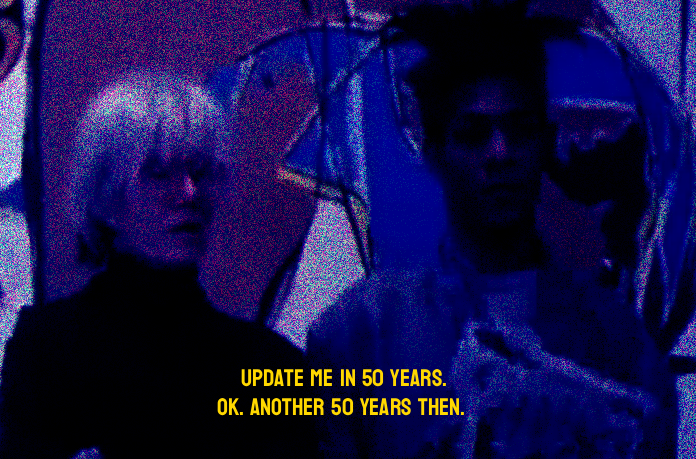
The cover image was created from a frame of an interview in which both Andy Warhol (who only became who he was because of his patrons and collectors) and Jean‑Michel Basquiat appear, an artist who received support from Warhol, one among many, in fact. The text is my own, and it needs no explanation; I trust you will have interesting interpretations of it. Anyway, if you wish, visit the Patreon at:
https://www.patreon.com/cw/VannieGama
I thank you for the time spent on this long reading.
We cannot live exclusively on pizza, coffee, and cigarettes. Or rather, slops, the online dynamic as it currently is. We forget to drink water from time to time, to cook and get some air. The epidemic is not one of loneliness, it is one of boredom.
Recommended readings: Patronage in the Arts: Theories and Contemporary Challenges, H van den Braber (2026). Artists and Patrons in Post-war Britain, C Art (2017), and The Patronage of Art: Conceptual and Historical Framework by Altun et al (2024).
Nota extra:
Mi solidaridad con el pueblo venezolano y mi resiliencia en tiempos de tensión (01/05/2025).
___________________________________________________________________
Share this:

Would you like to receive the next post on your digital door?