By Vannie Gama
Perhaps through the other retrospectives some of you think, “well, but he speaks so much of other years!”. “In the past” it was normal that an artist took a longer cycle to finish their works, or an author, or a scientist, who takes “times” without updates. I do not think we live in this moment anymore. Updates are constant. So, for some of you, maybe there is indeed this strangeness. However, I do not even believe that it is the creative medium itself that is shorter, but maybe the way of communicating it that is, in fact, more constant. Silences are less welcome. You know, I remember thinking that 2024 would be a year turned almost exclusively to create, without exhibitions or things of the kind, however, it was absolutely the opposite. At the same time, the effusion of events culminated in a longer process of some projects, and I believe that the connection between the years is also of a certain beauty, because the chain of events collaborates for the present, in a more organic way than the accelerated rhythm of any “final” product. To speak, however, is easier than to internalize and to do. Blessed and cursed time, playing tricks and never leaving a halo on the ground, without, in truth, being a chain.
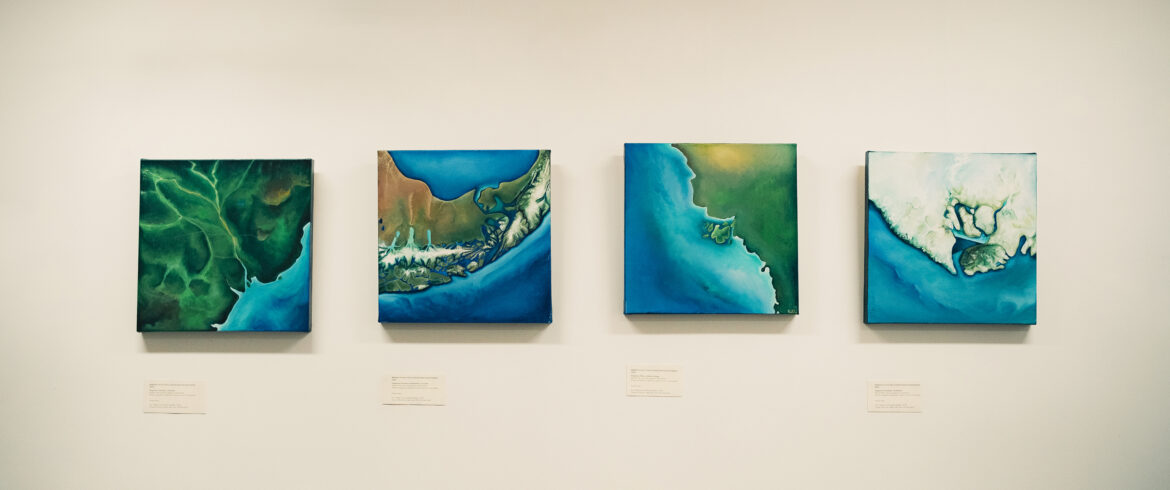
I told in another retrospective that the series of 2023, “Prologues for Organic Observations”, was a visual series, without direct representations of the human form, extremely focused on the meditation about the natures such as cartography and topography, the non-living changes such as glaciers and remains of the natures (branches, insect shells and old pinecones), besides in represented animals, cycles of forests, of beaches and hovering jellyfish in “Eternal Mutualisms”. Well. The idea of the prologues was born from the idea of a theoretical book of the same name, after the series “100 species of Brazilian fauna”, of 2020, when I was then, 23 years old. The question however is that I did not want to write this book directly, because I felt immature, so I wrote ‘‘O Cultivar das Imagens”, a book in the format of essay and diary of the pandemic, with collective works and social discussions much less theoretical than the original topics that I would like to deal with in “Prologues” — it was released during FLIMA 2022. However, I also did not make the series right after having the idea. Other series were developed such as Space-Being and Posthumans have always existed, not to mention the work ”59 minutos Inúteis” with the cellist and performer Luca D’Alessandro and Pedro Bortolin. In 2021 we spent the year working with the Syntropy States, as well as part of 2022 — they were sound-image works, and not paintings.
The Covid-19 Pandemic, it is worth leaving the record, was not only catastrophic in terms of the scars left in public health and in world diplomacy. In Brazil, it was a discredited pandemic, constantly disclosed and covered as something temporary, in such a way that the economic blow tried to be contained at the cost of the public hope of a quick phase of containment. This had an immense psychological cost. We lived monthly, weekly, in a state of euphoria by the news that guaranteed that the end of that situation was near. There were no forecasts that we would spend two years of that outside and one year really in quarantine. The current political-economic system did everything to make us believe that it would be brief. Imagine, to live weekly and monthly, with the “media hope” — obviously made to give time for the economic portion to protect itself and to “postpone” measures of real change in our calendars and routines as Brazilian society — of a better day, while scientists struggled to transmit the real information: that maybe it would last two or three months, then six or eight months.
It was a complex phase, because we could not make real plans. They were always sabotaged by the reality that we could have prepared for if it were not for the prioritization of means of production and commerce. Entire generations were affected at the age of literacy, young people who finished high school without a real last year of study, nor an effective transition to adult life. We of the cultural sector suffered a lot, and most of these activities were closed. Some migrated to digital, but most of us delayed rents, tightened the belts in all ways. None of this compares, however, to the thousands of people who lost their lives by negligence of sanitary crisis management. Besides the negligence that culminated in thousands of lives lost by lack of vaccines, propagation of methods not scientifically proven such as Chloroquine, denial and resistance of quarantine measures and misinformation about the use of masks, the worst, I believe, was to see these lives being jokes in the mouth of former president Bolsonaro in that year: jokes with people with lack of air, open disregard in interviews with the gravity of the situation. Pure inhumanity. For the lives lost between 2020–2022, my eternal empathy for the families who went through the results of irresponsibility of political power.

I say this about the pandemic because the pandemic not only created the first book, “O Cultivar das Imagens”, but remodeled my whole life project. During those two years of the pandemic, what I remember, besides the difficulties, was the strengthening of the artistic community. We united to support and to bring reflection, culture, information, and care to the population, each one as they could. Well, instead of immigrating to France “only for art,” staying in Brazil for those two years (I graduated in January 2020), made me not only unable to count on that, because the resources and opportunities dried up, but also made me have to look at what could be done on Brazilian soil. In a certain way, this obligation made me consider the academic world. I decided to do a master’s degree, but before that, I even did a semester of chemistry, which, as well as physics and philosophy, was a faculty I was in doubt to do when I went to visual arts. I was denied in the USP program, but I passed in the avant-garde FCA of Unicamp. I entered ICHSA — Interdisciplinary in Human and Social Applied Sciences, with a project much more practical than theoretical, Almarte, a name inspired by a work of art of one of my professors from college. I moved to Limeira, in the interior of São Paulo. In the second month living there, I adopted Carina.
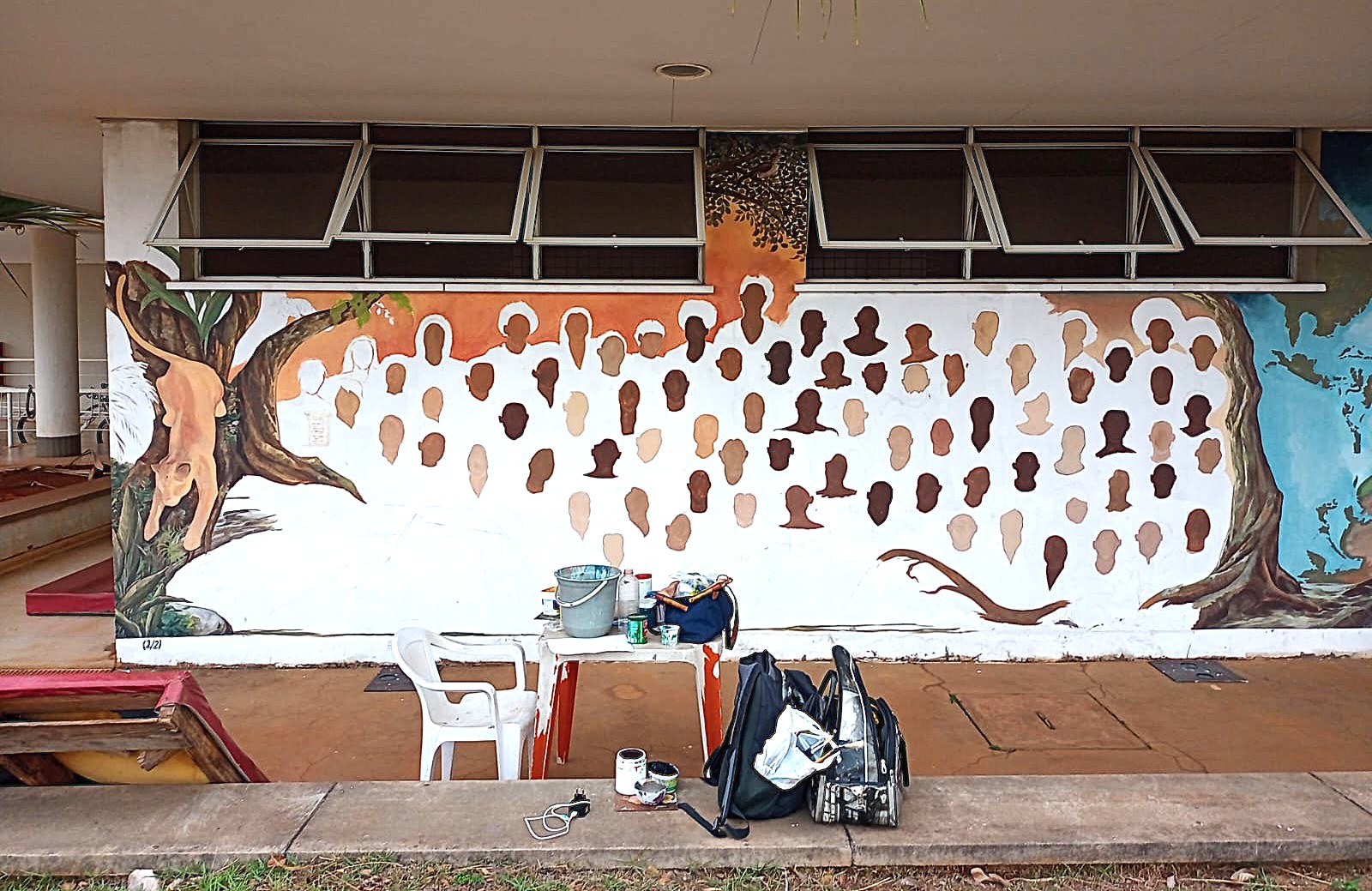
The formation in ICHSA of the Faculty of Applied Sciences of UNICAMP was essential in my life trajectory, even with some classic slips on my part, such as never having finished the mural “Southern Compass” — although I have to say that I did not receive for that, and to work for free for those who are not heirs is somewhat unviable, because the expenses in making a mural are high and only one purchase, once, of materials, is not enough for the hundreds of hours of work that we spend on these works. My advisor was Professor Doctor Rafael de Brito Dias, and he was a person who presented me a bibliography in studies of technology that would be basal for much of what I wrote in college and afterwards. He was an advisor who at the same time gave me space to work, supporting me in my scientific adventures, also knew how to correct my bad courses, my inconsistent and unpolished decisions.
The program also in fact offered support for what is interdisciplinary thought, and just as when I assumed myself a trans person from the legal point of view, something that changed my way of existing, understanding interdisciplinarity was also this naming, officially, a specific way of working in the theoretical field. So much that since then, it is common that in my biographies it is written “interdisciplinary artist”. It was an extension beyond interdisciplinary research. Moreover, ICHSA is a program of critical thought, and even if in terms of professors we do not necessarily have supportive thoughts for all the revolutions of the humanities, certainly we have a greater part that works with decoloniality, feminist and queer theories, applied research together with settlements, humanist geography, public policies that rethink higher education, to cite some lines of action — not only of thought. It is a humanist program.
I graduated then as a social scientist… humanist, with the making of arts tied to research. I met researchers and people that I will carry for life, that I admire and that I follow the research and activism, such as the work of professors in 2024 like Eduardo José Marandola Junior, Rodrigo Ribeiro de Sousa, Lais Silveira Fraga, Lux Ferreira Lima, Oswaldo Gonçalves Junior, Milena Pavan Serafim, Rodrigo Alberto Toledo, Peter Alexander Bleinroth Schulz, Juliana Pires de Arruda Leite and Carolina Cantarino Rodrigues. Not to mention, graduates of my class, such as Tiago Rodrigues, Mayara Sabineli, Yumi Wada and Marta Zapata.

My research transformed and when I saw, I was working with the themes of the context of the book understood for the Prologues, and at the same time, I continued the atelier, and thus was born at the same time the series”Prólogos para Observações Orgânicas” of 2023 – for which I am extremely grateful to other artists who helped me to set up the exhibition in Santo Antônio dos Pinhais — SP (the musician, art communicator and art educator Enya Yoshii and the photographer and film artmaker Henrique Nakandakare). I also published four articles and a book chapter at that time. Book chapter and cover of”Conectando Saberes: Gênero, Tecnologia e Informação na Era Digital” organized by Rubens Ferreira, and published by the Federal University of Pará in 2024. Rubens, by the way, a great researcher and wonderful person. We met during one of those events and academic conferences of UERJ — State University of Rio de Janeiro. In the master’s degree, I was quite involved with the project, with participating in events and making good friendships, at the time. However, it was not easy to write the dissertation. Life is not only creation, and I went through very difficult moments, such as a relationship that was the reason for much therapy, and mainly, the loss of my grandmother, Dona Eliane.
When I defended the dissertation, on June 12, 2024, I was told to publish a book from that work, in a more accessible language. However, the only accessible language that I can say is live, in workshops, round tables and, more recently, through fiction. I do not even have the capacity to revise my writings — but it is fine! Nothing to fear! I know that the writings of Edmund Husserl and Schopenhauer were also not beautiful in their “youth” — much less to make them digestible. It is already so difficult to take them out of the mind and transform them into something material. When I delivered 300 pages of dissertation, my advisor and the committee were not very happy! Well. The fact is that after a year, I managed to revise a little of the original work, and I made some important changes, such as the repositioning of the “Organic Manifesto”, the heart of the dissertation, to the beginning of the work and not at the end, resulting in a change of introduction.
For the rest, I decided to leave the first edition similar to the integral of the academic repository of the university. Even writing this retrospective, it was when I discovered that the dissertation was a highlight of the program. Anyway, in any case, it was in 2025 that I published it as a book by the Dialética publishing house. Although full of insufficiencies, publishing the dissertation “Technological Society: Nature, Modernity and the Years of 2020” was a huge milestone in 2025 and in the last three years. In it, there is the Organic Manifesto, something that if it depended on me, would be the first thing that any person would know about my work — not for being good or anything of the kind, but for representing, genuinely, the spirit of “everything” that I did and do in text and in paint, in a raw way, or, not so institutionalized. This manifesto was born as a suggestion of the master’s committee, “as an attempt to channel the strong militant spirit of the dissertation” that was disturbing it — it did not solve this problem, but at least it made a frank manifesto be born. What program motivates you to do such a deed?
Above then you can have access to a fragment, in Portuguese, original language of the dissertation available in E-book and physical version. It is possible to read the integral version, without book layout and without the last revision in the repository of Unicamp: Terminal RI – Sophia Biblioteca Web . Naturally, there is a partial closure, eclipsed, after all, I have not yet finished the book that motivated all the creations mentioned in these three years, and, deep down, I am still owing a publication, of Pop Queer, to in fact close the master’s degree. And even so, I feel that I will always feel in debt, for never having finished the mural Southern Compass. Who knows one day, when money is not a problem and I can spend a month making 100 portraits in 9 meters of wall, right?
You can acquire the book version of Technological Society through several platforms, and yes, I receive for these sales. Different from the works of art, these, I still have control over copyright besides the individual volumes.: Sociedade Tecnológica: Natureza, Modernidade e os Anos de 2020 – Irrigações através da diversa arte visual contemporânea brasileira – Livros Acadêmicos com até 10% OFF (Brasil) e SOCIEDADE TECNOLÓGICA | Casa del Libro (E-book, moedas internacionais). I did not make a launch for it, and of the two books of the year, then, together with “Lion the Unicorn”, I am thinking whether I participate or not in some event to launch them together with works on paper as it was with “O Cultivar das Imagens”. For this, I am considering either making translations of these works in the next Canadian events, or, going even to Brazil for FLIP — of Paraty, or for the Biennial of the Book of São Paulo of 2026. This depends completely on you, readers. And yes, with the closure of this cycle of 2025 (maybe only waiting for an acceptance for the article Pop Queer), I can finally work on the book that really generated all these works, however, probably, only for 2027, seven years after the first idealization of the thing.
It was a textual year, was it not?
See you soon!
Share this:

Would you like to receive the next post on your digital door?