By Vannie Gama
The myths around what originality is and how creation ”should” work are, perhaps, one of the pillars of the imaginary of artistic life for people who are not from the arts, while at the same time they can become equally unrealistic rulers for many artists. The point is that, if everything goes well, we are always learning from more experienced people and from those we admire (even if from them remain only diaries and interviews). The ”magic” of each creative process dictates a huge portion of the artistic identity that crosses us and consumes us. Far beyond the debate of whether ”there is right or wrong”, one thing is on the common horizon: it will be volatile and bittersweet. War and Peace, dissatisfaction and momentary peaks of satisfaction; numerous are the dynamics – not only the binary ones – that are part of the territory of materialization.
One of the workshops I most like to provide to the public is the creative process, precisely because of embracing this myriad of possibilities and demystifying a common objective when we create. There are, certainly, market demands or professional demands as a whole, that will require a well-polished organization, however, this is only a small piece of artistic creation and, I would say, has much more to do with an administrative side than a creative side per se. There are those who say that what distinguishes the quality of the artist lies in the daily ability of creation, of ‘not depending on inspiration’, and that this, in some way, is a mark of ‘professionalism’. I met great artists who make a work every six months or even the same proposal every few years, varying only the presentation of this proposal or the ”descendants” of a common root, such as, for example, reproducing the same performance for years or taking years to arrive at a specific performance. These temporalities of creation have some important cuts: incubation time, experimentation time, material resolution time and presentation time. I use here the word ”time” and not ”period”, because they are not necessarily processes with ”beginning, middle and end” established in an exact linearity and chronology, with divisions.
In each of these temporalities is where the works happen. Each medium has its details, and many of these processes do not depend directly on the ”energy of readiness” imposed on a ”routine” to a person of the arts. For example, it may take much more time in the materialization than in the incubation time and this, to the outside world, may appear as an artist ”who works more firmly” than for those who take more time in the incubation process, which I delimit here as being the process where we have the idea and work in the world of ideas, of sketches, of the ”hows”, but without yet arriving at experimentation, which can even be optional, since many artists do ”very complex projects” to make the ”final works” (materialized).
It may also be that all the processes are quick, but that the materialization requires waiting for any reason: financial, natural difficulty in arriving at a good material solution, the waiting for the space to work on this materialization, or even the waiting for the arrival of the acquired material. Depending on the medium, there is its preparation which can also take time. In other cases, these processes are all time-consuming, or all fast, but the worst will be the presentation time, where administration is the most important part, which is to find public, digital, institutional spaces to present that work (or sell it, after all), making projects ”not so time-consuming by nature” become time-consuming in the eyes of a world beyond the space of creation.
I am entering into this matter because, whether you, reader, public, artist or institution, will probably have perhaps instantaneous examples of artists (or of yourself) who relate in some measure to some of these dynamics and, it is always good to remember, that this procedural diversity cannot be totally domesticated, and there are natural limitations (as well as changes throughout artistic life) in how much we can fit these processes into the time that is professionally viable for us (between contracts, obligations, and personal needs of creation).
Understanding the artistic process itself, then, tends to be a continuous experience of acceptance and frustration, not only because of the nature of the ”driving force” of creativity, but above all because the world of ideas must be channeled through corporeality, that is, cross the medium that is our sensitive perception and our languages in the ”non-artistic” states. This channeling will have to pass through our patterns of behavior, whether good or bad, and does not have autonomy to transpose a superhuman idea. Desire and Representation (I will avoid speaking of Schopenhauer for the sake of merry and fulfilled people) enter into a clash, hardening the body and signaling in spatiality our own limitations. These limitations can be technical, but commonly they are material, fruits of social inequality, of the lack of time and structure to realize a certain idea. In both cases the methodology used will adapt, as far as possible, the abstraction to the ”material reality”, imprinting in the structure of the perceptible in the world sufficient symbology to apprehend the will of the spark that originated a given work of art.
Speaking in a less complicated way: you can imagine X, but not have resources to create X, and thus, make a new version, X-1 for example, or X (Z), to manage to bring an idea to some plane. To be ”doable”. This applies in music, as in visual arts and in all forms of art, even though it is evident that the demands will vary and the problems will vary according to the material demand of an idea – it will be different for interpretation, for script, for game, for cooking, for dance, for theater, etc. Generally it is in the incubation period moving to experimentation, or even moving to materialization that we realize what we need to study, accept or throw away.
An ”important detail” is that ”life happens”, while these processes and temporalities manifest, in such a way that the cultivation and the experience of a creative process do not follow a calendar, a day-to-day in the strict and unidirectional sense of the term. It is a process crossed by simultaneous demands, which delay new processes, and even if you only work on one project at a time (which is rare in the artistic world due to our ‘natural lack” of keeping ourselves in only one meditation, one discomfort and one motivation), the demands of an ordinary life, regardless of your lifestyle, will interrupt or extend several of these moments of the creative process, whether by interruption or by the simple and constant updating of the portion of attributes that are part of each moment. All this to say, that constancy is not something visible only by the ”act of doing, materially”, a work of art, and varies greatly for each artist.
After a huge introduction, we can then talk about this retrospective which is of my relation with ”Platitudinous Bizarreness”. My artistic process, as many already know, is a process whose research and conceptual organization take most of my time, and whose challenges of materiality are generally circumvented by the acceptance of what is possible to do in reality: I have many ideas that I will only be able to do in some good years, when I have resources and large spaces, and thus, many times, I remain in painting and, worse, in rectangular painting of medium dimensions, by necessity, and not by ”desired” solution. Many works, when I create them, are imagined together with installations, with performances, with material-digital integration, and mainly, they are laborious in kinetic ideas or properly ”edgy” in mixture of materials (such as my desire to work with glass, water and light, besides mechanical and kinetic works or a pressing of limits of form in painting, going further than I have gone so far with polygonal and round works, I dream of large panels that fold the visual space in ways we no longer see, but that were, in fact, even quite common some centuries ago – perhaps the most famous example being the chapels of churches or the huge murals in contemporary buildings [thanks to Street Art]). One of the things I could not do but would love to, was to make a permanent mural in some curved corridor, like in the Paris subways.
Unfortunately, as a reflection of my own choices in being highly selective with the places I associate myself and with the people who support my work (although this has assured me a cycle of which I am very proud to have in history or in the present), I do not have many resources for my creations. I chose a category of living with little, but authentically, at least in this first decade of career – if it is like this until the end of my life, all right, but if not, ah! I imagine and do not imagine what I will create with a little more material freedom. Be that as it may, I have remained in medium-format painting in recent years, even for reasons of practicality: larger works are more difficult to be transported over long distances, besides being more expensive to make and requiring more working time. The worst is that they require better ideas. Nothing is worse than putting a bad idea into practice in a materiality that was not easy to acquire, when resources are a concern, evidently.
This is valid for the visual proposals, however, as you also know, half of my practice is literary, even when visual. For it, the challenges are not material, but rather technical-procedural, in the incubation. Most of my ideas of theoretical research take years to come out of paper, not because I do not have access to databases or libraries, but because I know that I do not yet have the knowledge to put into action some certain projects. There are ideas from 2020, that until today, 2025, have not yet left the experimentation, of organizing chapters or structures. The article ”Pop Queer”, for example, took three years to find its final form, and the series ”Prologues for Organic Observations” took three years to find its visual form, and was transferred from a literary project to compose partially my master’s dissertation.
” As part of my creative process, I have some characteristics that have been better understood, by myself, over the years: what motivates me are large projects, not in the sense that they ”appear good”, but that their proposals are long and serialized, fragmented into sub-themes or sub-forms, or that are only finally composed in ”reasoning” by the integration of these individualities. Until today, only six individual paintings that I made, in fact, I felt some momentary satisfaction (Time into Flesh [2017], The Death of Mazeppa [2017-2018], New Flanerie [2022], Iridophores [2023], The Fourth State [2023-2024] and Senses [2025] – a gallery for this selection is available at the end of this text). None of them are for sale: all have already been sold or were properly collectors’ projects, and ”The Death of Mazzepa” is one of the few paintings that remains with my family in Brazil, a gift to my father, after I graduated from the Visual Arts college in 2020). All the others that do not belong to series did not fulfill me during their creation – not that this changes their inherent value, it is only a ”curiosity” of creative process – even in other media, such as generative art, sound-image, and performances. This attempt to create series began in 2017, intensified during the pandemic, with the series ”100 Species of Brazilian Fauna and Flora” (2020) and were being polished in the following years. “

The Heat of Creation. Oil on canvas, 50 x70cm, 2024 – Vannie Gama.
Initially, the series would consist of 7 works, numbered between 0 – 6, portraying these great socially constructed idealized themes, with an undertone of hopelessness and even the brutality of these concept-perceptions, which serves as a basis for the emergence of visualities focused on corporeality, on the human figure. This proposal is quite contrasting with the previous series, ”Prologues for Organic Observations”, where the entire setting of the series was the beyond-human, or the other-than-human, with animals, vegetation, non-living elements, etc. Thus, this return to the ”human tales”, including through an initially more closed palette, marked then a philosophical social thematic proposal, working in each work some great ideal – creation, the infinity of love, freedom or free will, to cite a few. As said in the very name of the series, it is above all about the ”banal strangenesses”, but I could never do this with realistic imagery, but rather through a more surrealist or imagetically playful symbolic language, which is constant in all the series so far.
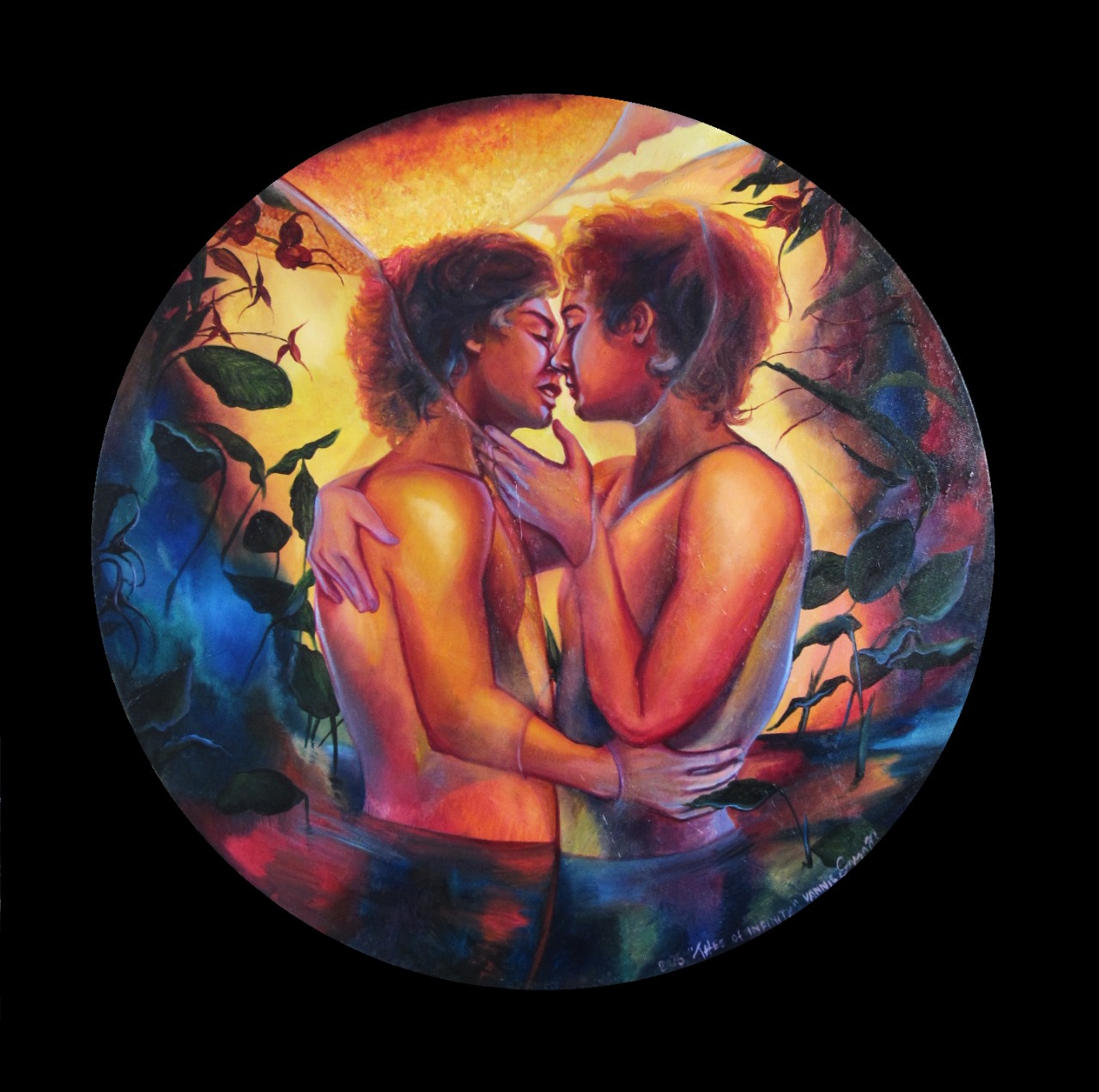
Cuentos de la Infinidad/Tales of Infinity. Oil on canvas, 90 x 90cm (Round Piece), 2025 – Vannie Gama.
While this series was slowly developing, all the other projects already mentioned from 2025 also demanded some attention, whether in the administration of the ”after completed” or in the finalizations and continuities required in each project. Something that was not in my calculations, however, was to pass in an artistic residency in a period of life transition – organizing the doctorate, which consumes quite a lot of our time in general, besides parallel works to keep the atelier supplied. At The Rabbit Hole, the theme ”Art of Memory” tied together some main themes of Platitudinous Bizarreness and with my experimentations with The Pairs. My project then, in Paris, would be an absolute immersion in the world of metaphor, in the rabbit holes in their most abstract senses and, with a constant contact with surrealist creation – since ”Alice in Wonderland” was very impactful for Surrealism at the time and, there was a huge exhibition of surrealism at the Pompidou in those same months of residency. There I created ”Memory as Delirium”, with the series the works ”Swan Lake”, ”Odette’s Resignation”, ”Hydromancy Through Tears”, ”A Broken Kaleidoorscope” and ”Siegfried’s Lock”, besides the collective works and entry works of the series ”The Pairs”, such as ”Daily Absences, Magpies Mornings” – In 2024.
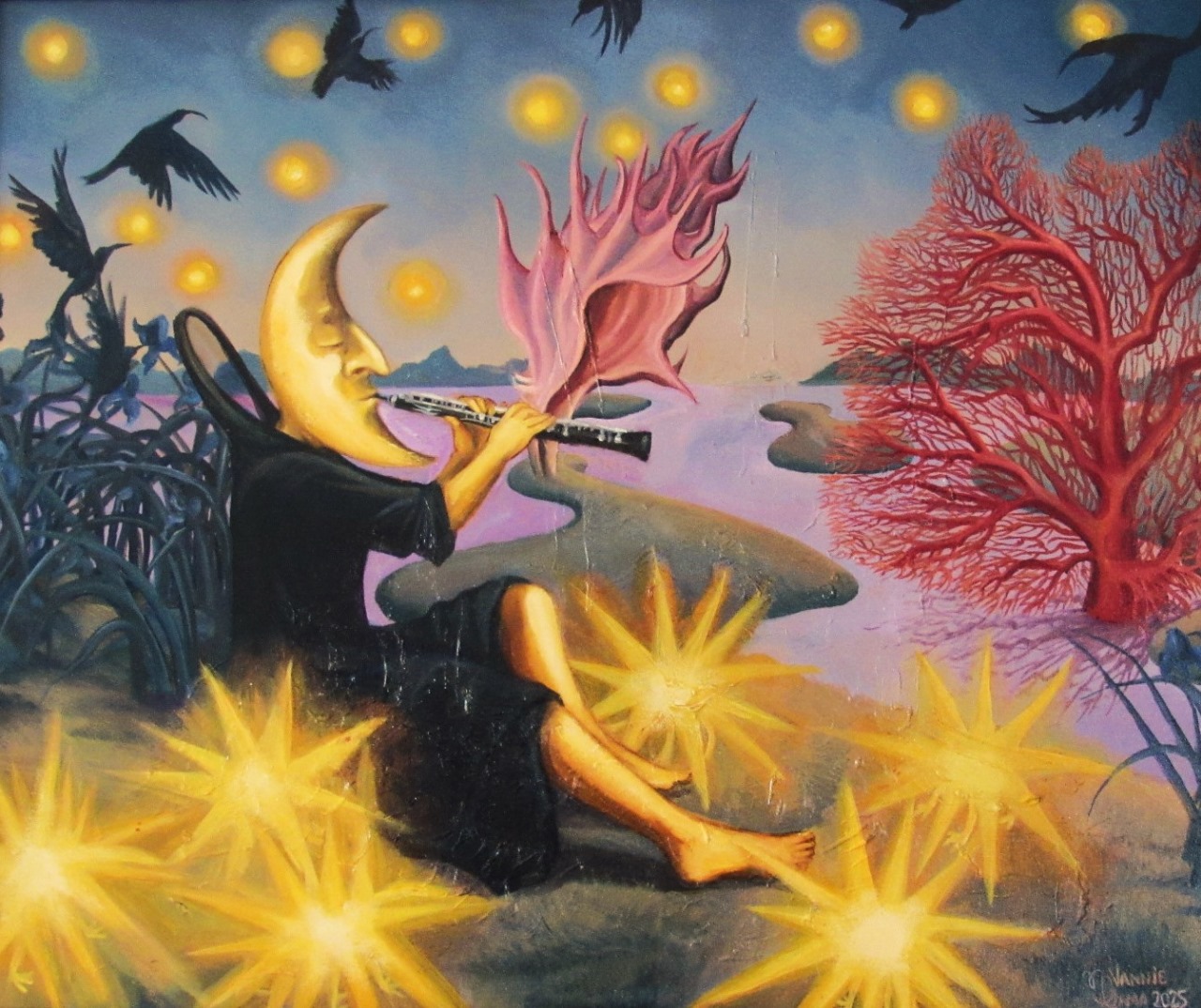
La Cadence de la liberté/A cadência da Liberdade. Oil on canvas, 50 x 60cm, 2025 – Vannie Gama.
In 2025, then, after the flow of the residency and the writing of ”Lion and the Unicorn” (in between, I also moved to another city, and was creating punctual works for the monthly auctions of Tableau), I decided to revisit the series. In this case, the two works, both ”Tales of Infinity” and ”La Cadence de la Liberté”, took longer than usual to be realized. Not only because of their references and visual forms more detailed than most of the other works in general, but because their support were recycled works, purchases of old decoration canvases from the 2000s (a better wood, indeed), which needed attention in their bases.
The base of ”Tales of Infinity”, for example, was a canvas with textures glued and finished with acrylic paint. I took weeks to make the canvas sufficiently smooth and redo the base. Besides that, these works shared the atelier with another series, ”Atrás do Tempo” or Behind Time. Mixed temporalities, the canvases coexist and quite distinct projects give space to one another in the atelier space. In the first work, the work zero, ”The Heat of Creation”, the themes are of the transformation of our immense internal stones into this overwhelming force, creator of mountains and islands, represented by this lava that depersonalizes us. In this canvas, this ”heat of creation” illuminates and does not fail to show the delicacy of the dexterity of the arts, represented in the ballet and in the background ”zero mark”, without light, without perspective, in the background of our personal hells.
Thinking about love is not a theme addressed in any of my works outside the paper medium. There was only one work, which was never finalized, that portrayed a lesbian couple, two old friends of mine who were a couple at the time (in 2017–2018). With ”Tales of Infinity”, romantic love is portrayed not as a depiction of two people in love, but two people who leave their bubbles, partially, to reach the other, even though permanently immersed in their own waters, with their own fauna and flora, that is, their own nature. The desire is visceral, and strives to reach the other.
In ”The Cadence of Freedom”, the human figure is not ”quite human”, precisely because of the absence of free will in an existential realism. What we can have, perhaps, is the freedom of imagination. It is also a satirical canvas of the movement that seeks to silence the LGBT+ community and remove rights of inclusion and representativity of marginalized communities in terms of access and social privileges, where the light calls, through an oboe, the stars, so that the day may rise. Freedom resides only in mutation, in plants that become birds, in lungs of the sea that become trees. This work was inspired by the work of a Latvian artist, from animation, there in the decade of 1980. When these two series are completed, I will bring longer texts about the works. For now, these introductions are enough.
Another year has passed and I only managed to create three of the seven works originally planned for the series, with the ”surrealist version of the dream world” having been finalized still in 2024, in Memory as Delirium. Something tells me that 2026 will not be the year in which this series will be finalized, considering the obvious focus I intend to give to Astropoetics and to the fourth book of the atelier, besides who knows what idea I will have for next year (although a long series such as the Astro, which has 15 works, plus a well-structured book, is already work enough for a year, especially because the Astro will be exhibited in its entirety. However, mini-series may happen, and as only 4 works are missing, who knows, there is no motivation for such).
And thus, we arrive at the halfway point of the 2025 retrospective.
Gallery of the ”out of series” not-that-bad works I have created within the past years.


See you next week,
Share this:

Would you like to receive the next post on your digital door?