By Vannie Gama
The decision to immigrate or to spend many years outside Brazil was like the structure of a pendulum that, for years, swung between trips that always ended with a return to the countryside of São Paulo. It was in my second year of university that I became certain it was necessary to leave the country. That bittersweet feeling of not belonging. I mentioned in the previous retrospective that my work, as a visual artist, was always much more recognized abroad than in my country of origin. For every five exhibitions, only one was in Brazil, and proportionally, for every twenty applications sent to Brazilian art salons, one or none would be accepted. The artists I admired had also spent a period outside the country, and the Brazilian intellectuals I admire were only recognized “much later” in life.
So early on, at nineteen, I understood that the path would not be simple. I was “always applauded” for my technical ability, which was bad, but apparently “eye-catching.” However, what interested me conceptually or formally was never recognized in the “real art world” of 2018-19. There was a constant mismatch of trends; when I began to take an interest in ecology, it was not a trend the way it would become years later, and the way I approached it did not follow the tendency toward ephemeral installations and assemblages of diverse materials, which is still at the heart of contemporary Brazilian visual art.
Unfortunately, I was never good at performance. It is my favorite art form, and so I remain in the audience, admiring great contemporary performers; sometimes I venture into experimenting with this form of art, but I prefer to write about it, understand it, and keep close to me those who truly are performance and who share with me what it means to live in the art of presence. Back in visual art, perhaps my applications did not praise enough or did not show any networking: I was not affiliated with galleries and had no cultural contacts; my parents are not from the artistic world, nor is anyone in my family. My materials were not polished, and I could not afford to hire photographers, project agents, or anything elaborate like that. The funny thing was that with the exact same material, the international scene opened its doors effortlessly, while in Brazil I kept noticing that most salon artists knew other salon artists, knew directors, cultural producers, and well, I was in the library, or in front of the easel, or simply living in completely niche places that, honestly, I would not trade for popular events.
All this drama was reiterated by the contemporary artists I had the chance to talk to, and by the producers I would meet later in life. And it was even worse when I learned how things actually worked. If today I still struggle to greet people simply because of the position of power they occupy, imagine my twenty- or twenty‑one‑year‑old self, even more rebellious about this idea of “begging” to have the “bare minimum”. Seeing the social differences made this perspective even sharper: if I, with the privilege of attending a public university, even while living in a boarding house and not having the social life most of my classmates had in terms of parties and events because I could not afford to join them, had no money to buy canvases and painted on pieces of discarded furniture, or saved money for a few canvases from time to time (I only got a wooden easel at twenty‑four, in fact), imagine the people who were not even there, who could not attend university, who could not even save for a canvas once in a while. It is an absolutely cruel world, a grinder of dreams.
It still revolts me to hear anyone say that “there is prejudice against people who come from wealthier families, because a name is not everything”. Of course it is not, but I can assure you that if you have the money to study at a truly good university, do not have to worry about food or materials, and on top of that have contacts because someone in your family has already built that structure around you, you can be certain that your talent will expand in a way that most other talented people will never have the chance to experience.
Not to mention social privilege. I may be a trans person, but I am fully aware that being read as white also places me in an immensely privileged position compared to my friends who are also trans but racialized, for example. We are living, as a society, in a moment where every social and human right is being labeled as ideology. If you have a problem with someone else having access to something you already have (in the case of people who want the right to dismantle affirmative action policies, to be openly racist or intolerant toward other genders, xenophobic, and so on), I have only one question for you: what trauma wounded your ego so deeply that you cannot welcome another person? And do not tell me “that’s not the reason,” because there is no other explanation for refusing to see someone else have rights that are called “advantages” or “artificialities,” except the childish desire to exercise power over someone weaker in order to feel that difference between what you can have and what the other cannot. It is disgusting.
For me, any attempt to legitimize the cycle of hate speech and oppression that has historically targeted anyone who is not normative is completely unbearable. All of this needs to be said, because it is not plausible for me, as an activist, to abstain from the neoliberal political reality that is literally victimizing thousands of immigrants, those of us in the LGBT+ community, the Black community, and, I must say, especially Indigenous communities in the Brazilian context.
Any retrospective I write in the coming years will continue to include, at the end, some comments on the collective year. In 2025, it was a year of social setbacks, a year that perpetuates genocides and lays the groundwork for new persecutions or the intensification of those already underway, as well as a year that was absolutely shameful in terms of diplomacy regarding the climate crisis, digital sovereignty, and data protection, not to mention the increase in violence against women. The issue of technology and the lack of regulation of Artificial Intelligence and Social Media is a separate battle, without a doubt. At least, as something positive, Brazilian democracy is functioning and serving as an example to the world of how we must not tolerate attempts at a coup d’état, irresponsibility in leadership positions concerning national public health, and how resilience against coercive attempts from other countries is possible. We are not anyone’s backyard.
Returning to my paper‑boat existence, it was by learning from other artists and professionals, and from my own artistic experience, that I realized the path was not one of eternal permanence in my country of origin: traveling for long periods gradually became a refuge from the frustrated attempts to create professional roots. The roots I have in Brazil are not related to market or curriculum; thankfully, those roots are the natural landscapes, the queer community, my family, and all the reasons to plan my 2026 vacation there, where the “remaining” Atlantic Forest still exists. Without favoritism, but with favoritism: Minas Gerais is the place where I feel most connected, although I still need to get to know the North and Northeast of Brazil. Brazilian Drag Art is, like the natural landscapes, the most solid and most vibrant of contemporary performances.
To be very honest with you, the Canada plan was not, for anyone who knows me, the “life plan.” Things in life are not that controllable. For a visual artist, it is not as if Canada were one of the main global hubs (let’s be frank), but from the perspective of cultural diversity, social integration with the natural world, efforts to rebuild ties with Indigenous nations, and in geopolitical terms—something we do need to consider for long‑term plans—it is an extremely attractive country. As a non‑binary trans person, I need to think first about my safety and quality of life; after all, we have this digital space that goes beyond geography, allowing us to move beyond professional goals tied to a single region.
Since half of my life is connected to research, I thought it could be an interesting experience to pursue my doctorate here, to finish “maturing” my technical and conceptual artistic quality, and perhaps embrace a traveling life, with seasons in Europe and trips to Latin America and Asia, while returning to a place that offers an intellectual and cultural home more than a strictly professional one. After the doctorate, it is another story; it is far too early to know whether I will try for permanent residency or not. What I mean is that I did not come to Canada with that “hope” of “boosting an artistic career” “at any cost”. Quite the opposite.
Looking at Canada with sobriety, embracing research and culture, allows me to do something I have always wanted to do: focus on refining my work and affiliate myself only with institutions, events, centers, festivals, fairs, and even galleries that I genuinely believe are aligned with my principles, causes, and with the way I understand a “healthy and authentic” contemporary art. When you live with very little in order to maintain some authenticity, deep down it also prevents you from studying, since the rush to pay the bills drains any long‑term “unpretentious” project, and on the other side of the coin, “getting jobs that pay well” enough for you to live with dignity in Brazil will probably not leave you with enough free hours to dedicate yourself to artistic life at a high level, and that ends up pushed aside, because the priority becomes resting enough to endure the job that gives you “comfort.” Both options were absolutely destructive, and the first one, which I lived for seven years, did not allow me to concentrate on studying the way I truly needed.
That said, you can be sure that everything I do here will be only with places that “represent me” on a personal level before an artistic one, and this time without having to choose between a tube of paint and dinner. I am very excited for this Canadian phase, to be able to create from a place that is more comfortable but at the same time more authentic, not less. However, of course, the first months here did not reflect that freedom. Everyone says how immigration is a process that “is not for everyone,” because in fact it “almost” “resets” your entire experience, especially when you arrive under not‑so‑privileged conditions: not coming because you already had family here, or not being from a social class high enough to “arrive with permanent residency” and without worrying about income (for those who live off passive income or fully online businesses). When you arrive with two suitcases and a cat, well, things are not that simple. The transition is saline. If only it were bittersweet.
Speaking of transition, this long process of spending years outside the country is not simple even in the country of origin. Living alone, it was thanks to my family, to my parents, that I managed to lock the apartment for the last time and return the keys to the place I rented in Brazil, as well as arrive at the airport and leave artworks at the collection points so they could travel across the country. How grateful I am for those three is something that cannot be translated into text.
The last artwork I made in Brazil was “Sentidos” (Senses), right after the series “Atrás do Tempo” (Behind Time, at Neuromat) and works that are not included in this retrospective from the Platitudinous Bizarreness series. And this piece was not simply the last one; it had a completely different creative process from the others. Commissioned by a very dear Aries art collector, it was not requested only with “theme and form”; it was born from the challenge of making something uncomfortable, of stirring one of my emotional caves and extracting from there whatever was important. I am very grateful that, in the last four years, I have had only collectors and projects coming from people who were not looking in my work for the mere representation of anything visible, but who always ask me for something conceptual that borders on what they do not know and what I do not know; together we discover a place that becomes materialized after building topographies sculpted either through conversations and conclusions that are more existential than aesthetic, or through scientific and historical research.
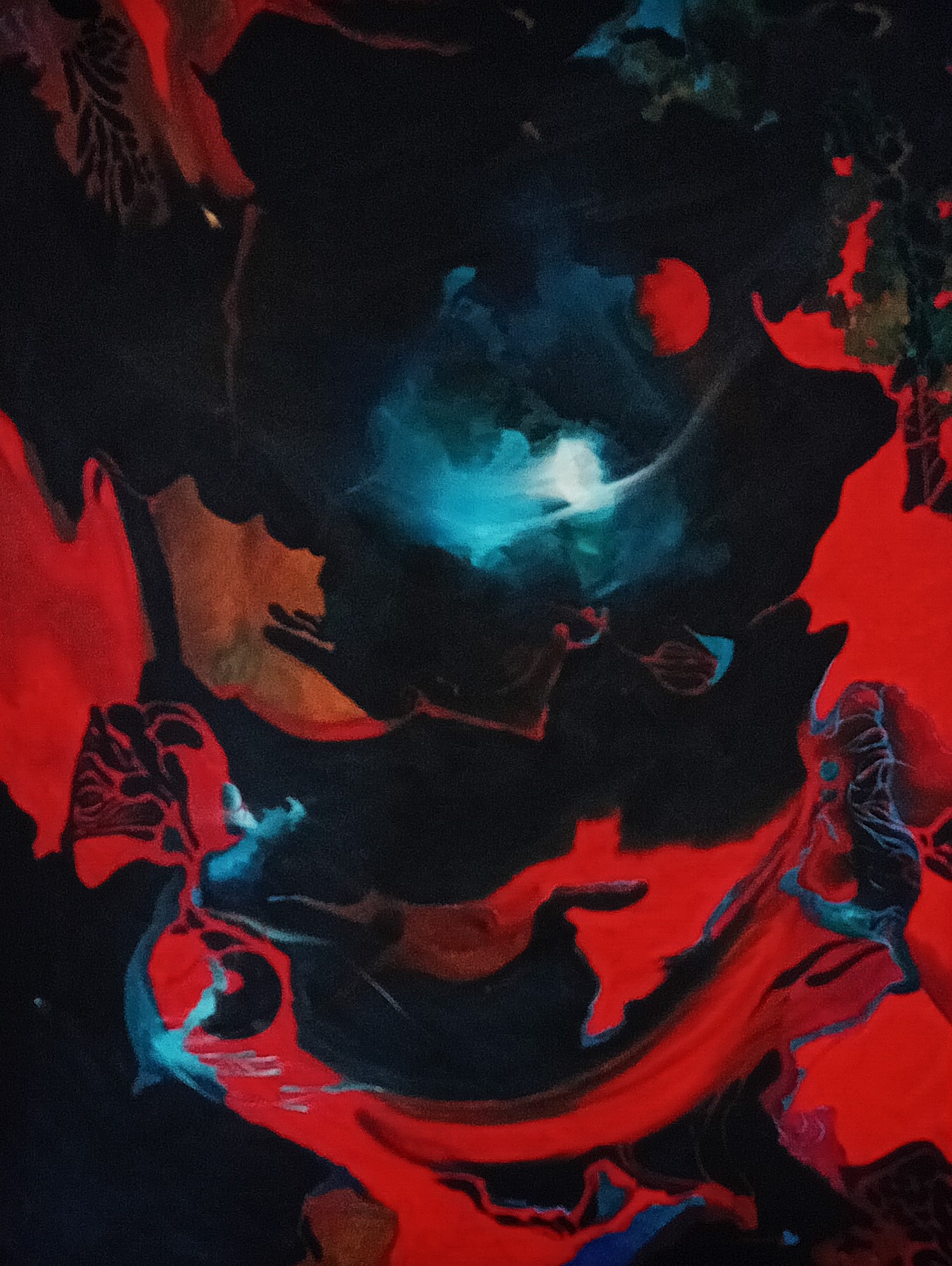
“Senses (Sentidos): Questions and Answers” was an acrylic painting, with a creative process designed to be diametrically opposed to my usual approach. The result may not have been aesthetically inventive, but conceptually it was, and that marked a huge milestone among the works I had created up to that point. However, I will leave a conceptual sheet available only in the 2025 catalogue, “Fruity Sadomasoquista” (nothing figuratively explicit, do not worry). The piece was one of the last things to leave my apartment, and it went along with eleven others, including “Formas de Watu” (2023) and “Nest” (2018), as well as a peculiar sale: the folding screen from my studio, painted by hand.
Arriving in Montréal, slowly furnishing the house in a tiny room, having a new easel and starting the studio from scratch also meant discovering the best and worst art stores in the city. I came across a different configuration of canvases, with a “cross” on the back instead of the 90‑degree angles in all four corners, as in Brazilian and European canvases, not to mention the vertical stabilizer for medium and larger formats. I found a gem in the city: Kama Pigments. If you, as an artist, ever come to Montréal, do not miss this small wooden‑floored shop, with the best walnut oil I have ever used and some pigments that are quite rare to find around the world.
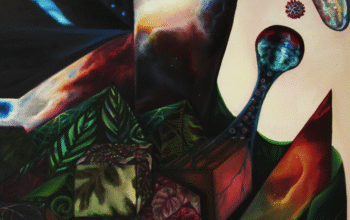
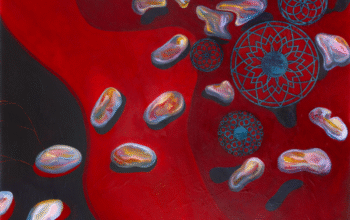
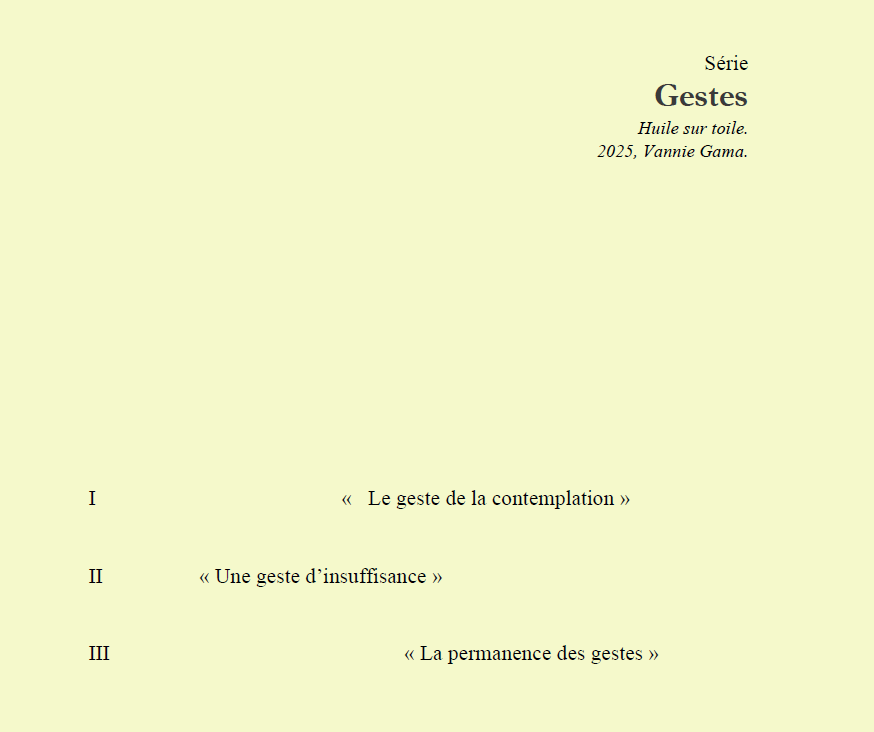
Thanks to a very avant‑garde course in my master’s program, I was able to begin the first series in Brazil. Quite different from “Atrás do Tempo” and the single piece “Sentidos,” the series “Gestes” would come with a political weight that runs through it in three acts: “The Gesture of Contemplation,” “A Gesture of Insufficiency,” and “The Permanence of the Gesture.” Their technical sheet will also be fully available, with the list of Palestinian butterfly species and the flora species integrated into them, in the new catalogue. But I leave here the image in the order of the three creations, with sizes in inches. In a rather unusual way, the trilogy was created in six weeks, each one on a canvas of different quality, since it resulted from testing different stores and materials here in Montréal. They were exhibited in a morning studio session still in 2025. Painting here has several differences compared to Brazil, given the difference in humidity and overall temperature, at least in winter.
In any case, I am quite excited to develop the next series and to truly return to “Astropoetics,” which ended up being interrupted first by the flow of activities at Neuromat and later by immigration. I am not living in a very large space, so handling more than one visual project at a time is completely unfeasible. My wish was to paint those enormous panels, larger than one and a half meters. However, because of the space, I will have to continue, at least until I am able to move to another apartment, making canvases no taller than one meter. It is quite a contrast, my last two studios compared to the small space I find myself in during this first year.


The “Gestes” series has several details to compensate for the size, from obvious references to the colors of the Palestinian flag, to the book held by the character in the first canvas, to the items arranged in the second one, and so on. All the species inspired to create the art works are available at the new catalogue MIST, where I can share details on this moment where art must be what it has always done: be part of the historical and contemporary voice, the shouts against genocides and the lost of human rights, in which not a single minimally sensible person should walk away from expressing their discontent – there are many ways to do it so, from the most delicate and subtle ways (as sharing the situation among local communities, digital or personally speaking, breaking down incipient argumentation to sustain these anti-human practices such as war), to a research work or in communication, such as journalism and newsletters, or beyond, for those who are able to do active changes in public opinion, publich speech, public policies and diplomacy. And, of course, in the artistic community, where all languages are needed, from cinema to music, to dance to visual arts.
This catalogue is quite different from the 2024 Handbook, and I believe that in it, the full intensity of the changes, the events unfolding without pauses or breaths, the weight and the cost of creation (literally, because at this moment I can no longer paint due to the lack of surfaces, and I will have to wait at least until February to work on any paint‑based project for financial reasons) becomes visible. Between Sentidos, a viscerally personal work, and the Gestes series, a series immersed in a shameful historical stain for humanity (for leaving it unpunished, just like other genocides on the African continent), it becomes clear that 2025 was a year in which there was a convergence of method, technique, all the usual research, but with a much greater and more concentrated dose of the desire for projects with broader scope, less restrained and less concerned with “how they will look,” and much more with the urgency of their realities.
And this is the end of the 2025 retrospective.
Now, with all this context, the year’s catalogue will make sense. In fact, this catalogue will have two versions: a free pre‑print containing only the main series of the year, and a second published version, with context from previous works and from the December 2024 series that generated the book Lion and the Unicorn. A list of publications accompanies both catalogues.
See you at the Winter Solstice.
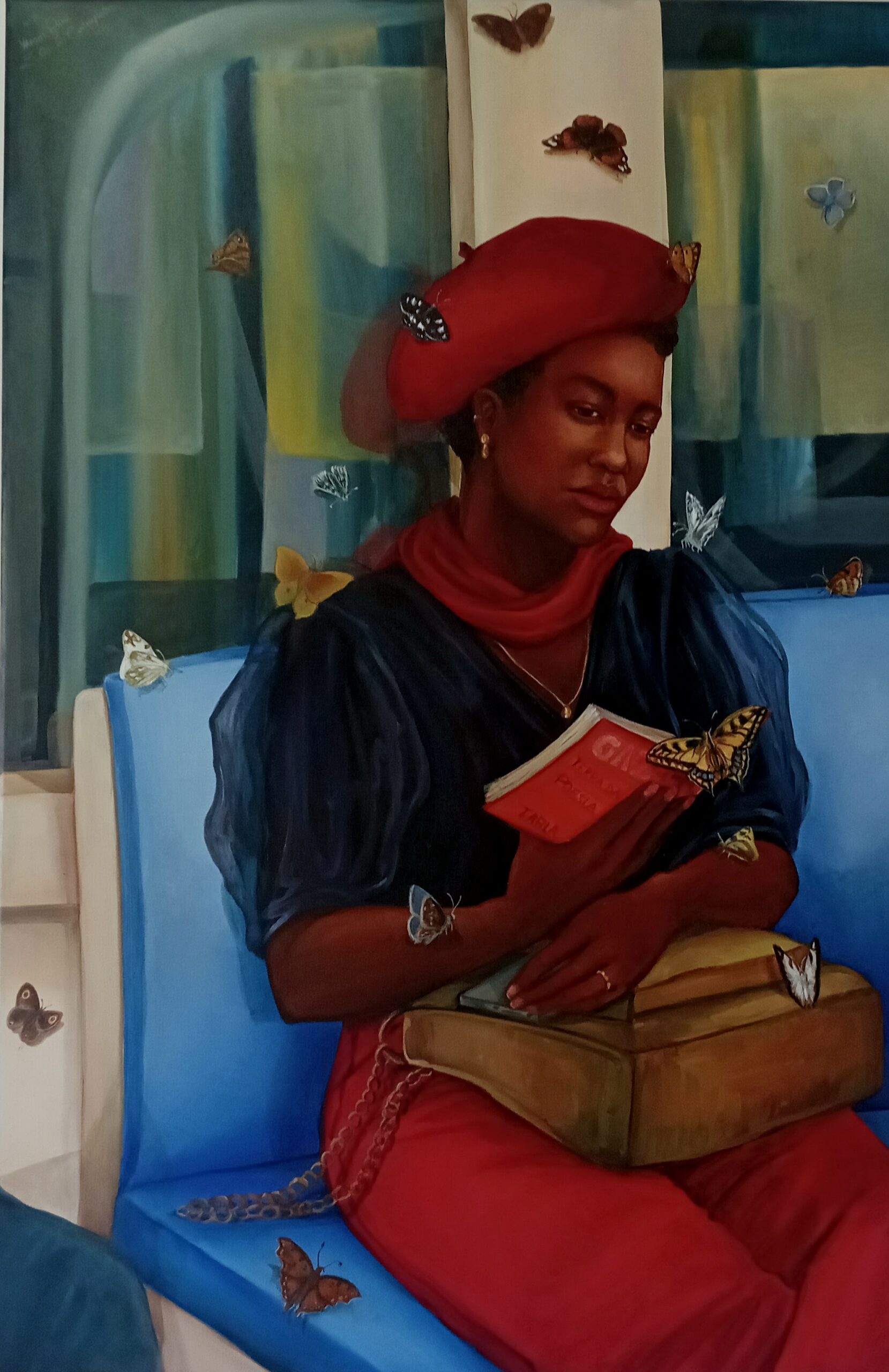
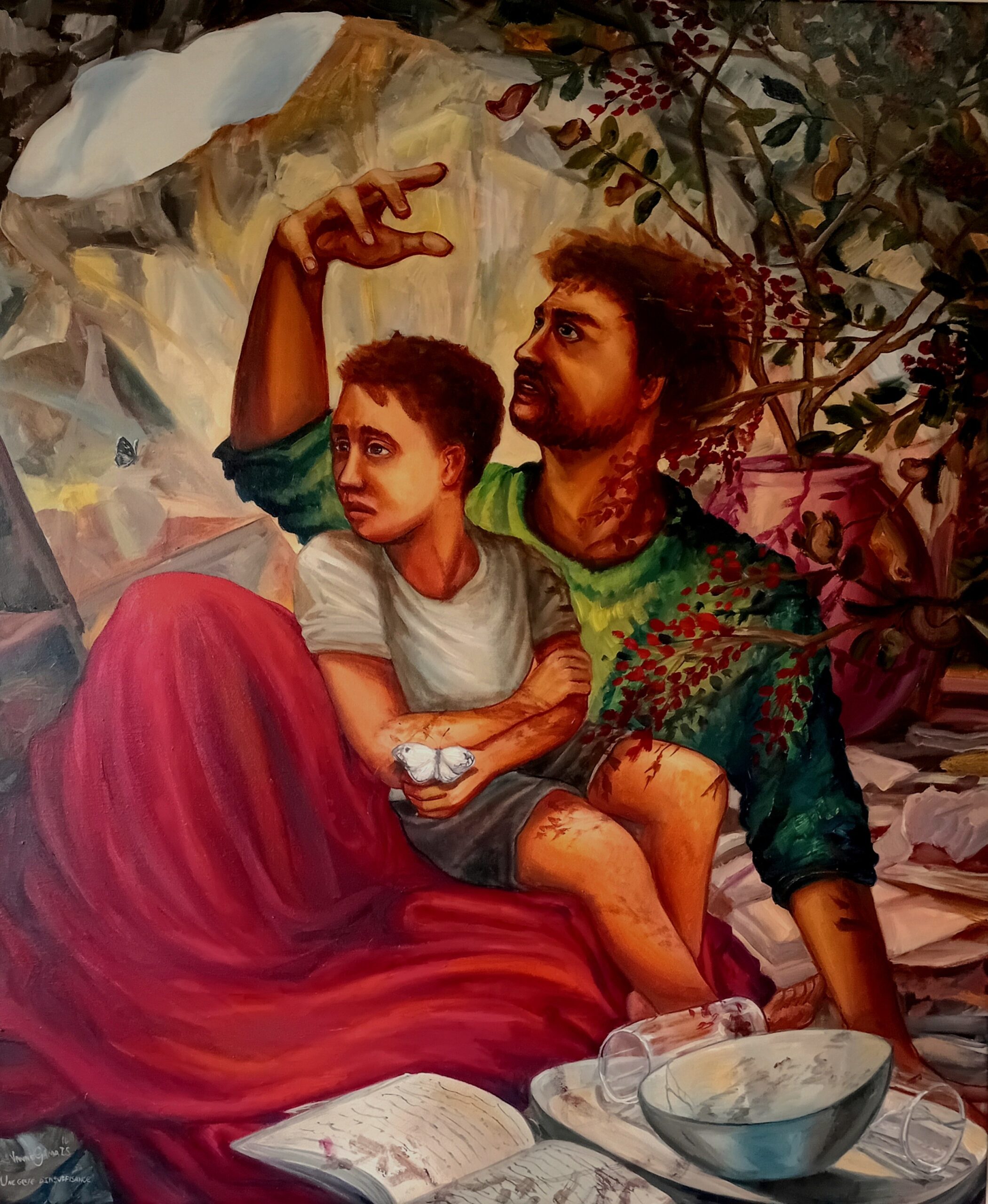
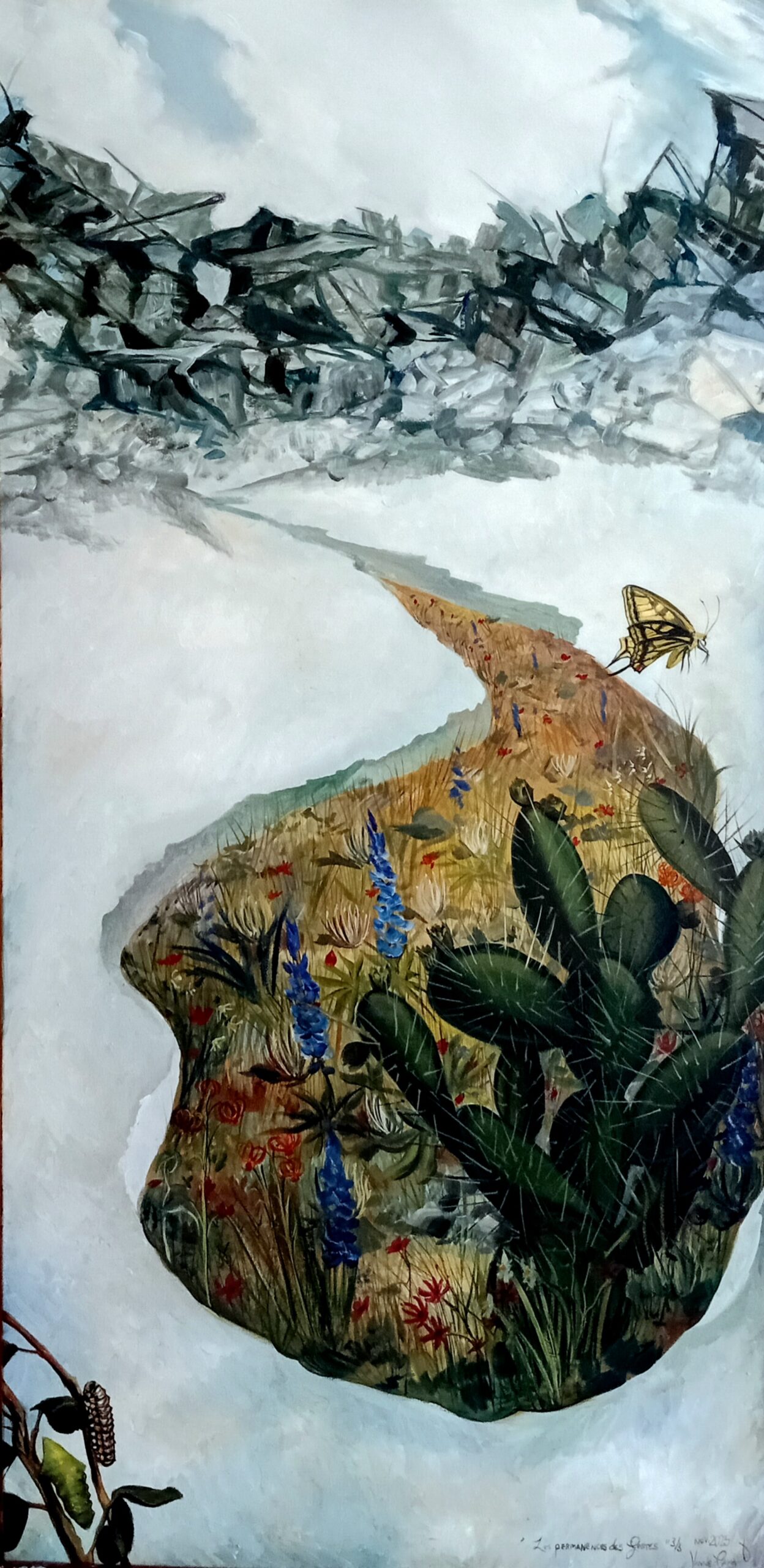
Trilogy “Gestes” first series in Montréal, series against the genocide in Palestine. Oil on Canvas. 2025.
From the River to the Sea,
For co-existence between different cultures, which will never mean an ethnostate resolution.
____________________________________________________________________________________________
Share this:

Would you like to receive the next post on your digital door?