By Vannie Gama
With each one of these retrospectives, there is that double feeling of, before starting to write, sensing that it was not a “sufficient” year – we really are sick with the ideal of productivity – and then, when organizing the material that gives rise to each of these texts, I understand that, in truth, 2025 was the most important year so far, besides having been quite prolific. Not necessarily more important for any reason related to capital or accumulation, or something considered “successful” in a “currently popular” way, but in the sense of the quality of things, of cycles and phases, of what I will certainly remember decades from now, clearly, as one of these milestones.
In addition to two books, two series, about 30 texts (between essays and articles), a series of 25 paintings (this one will not be in the retrospective because it is a “spin‑off” project from the atelier, which we will talk about in 2026), some smaller works, starting my doctorate, and having immigrated (at least in the sense of spending a good number of years outside Brazil without it being “traveling for work” every so many seasons), there was still something fundamentally important: having taken, for the last time, works to the Tableau catalog.
Despite the discretion of the auctions, I believe it is possible to share in this retrospective the importance that this house had in my work. First, Tableau Artes e Leilões is one of the most traditional auctions in Brazil and in the State of São Paulo, founded in the 1970s. The acceptance of works, as in any auction, was a rigorous and serious process of portfolio, biography, and those usual things. I was 21 years old when I sent my portfolio to Tableau, with that feeling that it would be one of the five hundred places that would tell me “no.” The year was 2018, and I had just returned from an exchange program in the philosophy bachelor track at Universität Heidelberg. I found the auction on a Brazilian art‑call website called “Mapa das Artes.” After years of sending things to that website, only twice did something “work out”: Tableau, and an exhibition in Paranavaí, in Paraná.
We do not need many “yeses” in life, or at least not as many as we are desperate to obtain. I was accepted with a single work, “Leis da Predação,” from the previous year. This work was one of the three exhibited in one of my first group shows in the city where I was doing my bachelor’s degree in visual arts, in Bauru, in the State of São Paulo. I even remember a professor of mine who, at the time, offered to buy that same canvas, and I, stubborn as always, said that I would not sell it. A year later, I sold it for a price that did not cover the travel to the capital of São Paulo state, where the auction is located, but it opened the doors for the next seven years of annual exhibitions.
This canvas, “Leis da Predação,” is a composition of two anthropomorphic figures, an Onyx and a clouded leopard, where the feline figure “frames” the Onyx figure, against a gray, somewhat surrealist background. At that time, this was a common poetics in my work: lazy backgrounds in tertiary colors, astronomical elements to which I dedicated myself more, and central anthropomorphic or somehow “surrealist” figures. I was reading a lot of German philosophy at that time, in addition to studying astronomy quite a bit – participating in university events in those areas and so on.
I never understood why the owners of the auction accepted my work. I had nothing besides a pile of theory and very few annual creations. It is true that the following year I would win my first international award, but at that moment, in 2018, I believe I had done four or six group exhibitions at most, with two “solo” shows that were really just very informal cultural events in the city’s autonomous cultural houses, plus two international events in the same format.
What may not be evident is the effort required to bring the works there: six hours by bus, plus a subway ride. Throughout those seven years, I always transported the works wrapped up on buses and public transportation, except for one or another exception with glass‑framed pieces, after two negative experiences that ended up cracking them. I never had much money for these undertakings. The auction space was already enough for me — simply being able to be there. I always had difficulty being part of the Brazilian art scene, which is quite curious, since I dedicated myself equally to national and international art while living in Brazil. Aside from the August 2018 catalog, the first one I was part of, it took me a year to exhibit at Tableau again, precisely because it was unfeasible to travel six hours there and six hours back to deliver a painting that certainly would not pay both the itinerary and the materials.
It was, in fact, in 2020, under the pressure of the pandemic, that, living a bit closer to the capital, I decided to start taking the creations myself again, with consistency. It was like that—masked and vaccinated, in that apocalyptic quarantine atmosphere—that Tableau once again became part of what would turn into a habit: packing artworks so they could survive the bus, the subway, and a few kilometers on foot. It was a learning process. I sewed the bags, learned to pack “perfectly” within my reality, learned to let go of “important” works and at the same time understand that artistic life is a long‑term calculation; there are works to sell now, works to sell in a few years, works for direct collectors, works for institutions, and works for auctions. It took me a while, and I learned “the hard way,” that artistic life is at least half administration. It is no wonder that entire teams are responsible for careers. Doing everything alone is absolutely exhausting, and without the guidance of a team “handling everything outside creation,” direct flights into the abyss are almost inevitable. With time, we begin to understand how things work in each niche and locality.


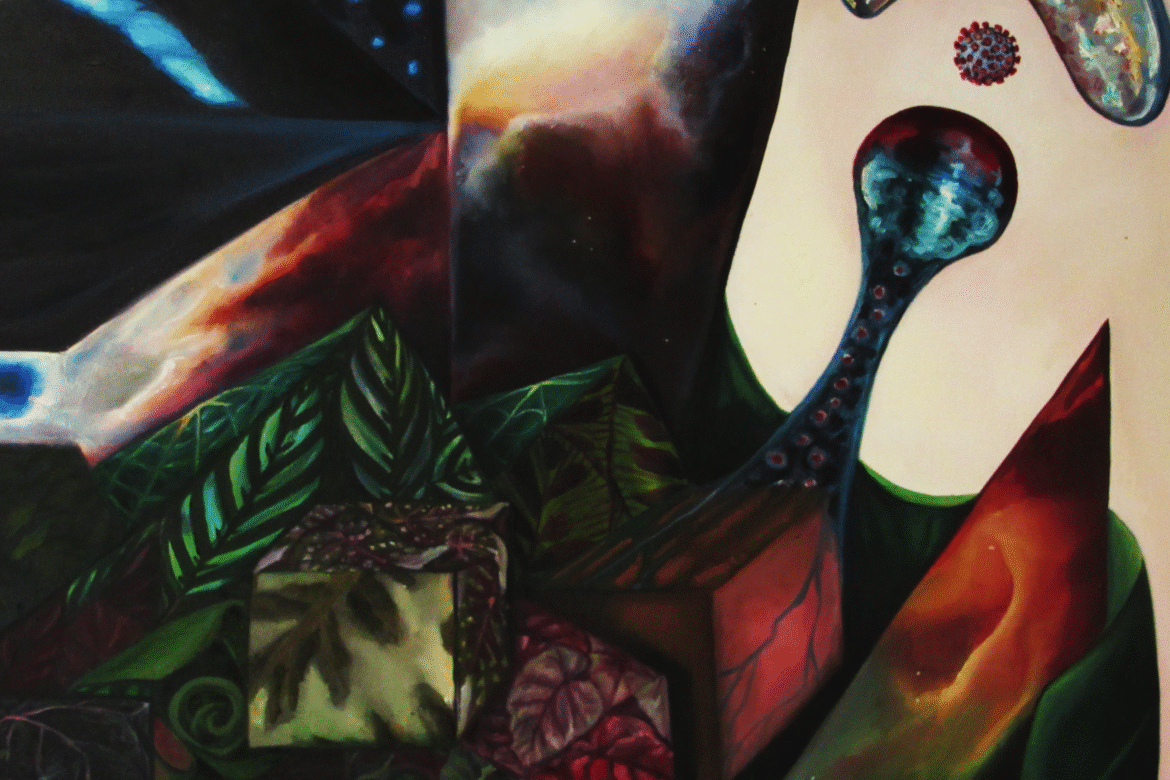
Artworks from 2023–2025 sold at the São Paulo art auction house “Tableau Artes e Leilões”
Starting in 2020, the second “serious and legitimate” year of my career, exhibiting at Tableau became a wonderful ritual: arriving at the address on Rua da Consolação (at the time), ringing the doorbell, climbing the stairs, leaving the works with the staff, and chatting for a few minutes with the contract managers at the reception, who were also two people almost my age. Once in a while I met the auctioneer—first the father, then the son—who, in the first two years, gave me chills down my spine because of the “contrast” between “me” and “those people”. I always thought, “what if they change their minds about accepting these artworks…?” In my mind, that always seemed plausible. It never happened. To be precise, it happened only once, when a work was not accepted for being smaller than 15 × 15 cm.
Hence, in the light of such events, from 2020 ahead, my name‑half‑grain‑of‑sand was among enormous dunes of artists I had only ever seen in museums: Salvador Dalí, Max Ernst, Tarsila do Amaral, Abraham Palatnik, Mabe, Portinari, Banksy, Anita Malfatti, Miró, Fukuda, Oscar Niemeyer, Djanira da Motta e Silva, Tomie Ohtake, Léger, Kadunc, Walter Lewy, Maria Leontina, Bandeira, Volpi, Di Cavalcanti, among dozens of artists from other centuries or far older than I was (and am). I was the youngest artist “of the house” during all my seven years there. I was also one of those who earned the least—after all, half a grain of sand is still half a grain of sand among dunes. I experimented with bringing different works, on different supports, to see the “results” of the auctions. It was during this period, between 2019–2022, that I understood “what I am doing” artistically, and that I could not make “anything to please the public”, in a way that the natural pathway was the great coincidence when the public was pleased by what I would be doing anyway.
“Selfish and disruptive,” in the systemic and not the aesthetic sense, I would have to learn to navigate around some of the common paths of the art world, and thus I was already grateful to have a place that accepted my works, whatever they were, where, in the worst‑case scenario, the outcome would be financial indifference. I learned that few things are more valuable than spaces that allow us to experiment and develop, even if we suffer, like everyone else, the same effects of action and reaction that come with these experiences (such as not making up to a living in the first one or two years of dedicated work).
And so, over seven years, 84 of my works were sold at Tableau. No matter what was happening in my artistic or academic life—literally, whether in Brazil or in Japan—one thing was certain: every two months, one to three canvases would be prepared for the next catalog. It was through Tableau’s audience that I had the privilege of meeting art collectors, people who would actually take the time to read each long conceptual description or creative‑process note of the series and works, and who would come to talk to me about the pieces they had acquired.
It was completely different from selling through direct sales, to a direct or university‑intellectual audience, or to the public at events. It was where I understood that it was “all right” to “work this way”: slow, anti‑systemic (in the sense of going against “maintaining a single style and maintaining a single theme”), critical (theoretically, conceptually), and moving across a wide gradient between “digestible” figurative work and the pieces that “are called abstract” “but are not” (such as the works from the series “Prologues for Organic Observations” or the trilogy “Impossibly Simple, Time’s up, and Life and Death,” all between 2020–2023). It was okay to be complex, to create intricated backgrounds before painting something rather simpler, in a distinctive way to bring to life a bridge that they could cross. Parallel to the auction, my artistic life involved collaborations, events and festivals, publications, group and solo exhibitions, interviews, workshops, interdisciplinary projects, galleries (I had that phase), art fairs, and the chaos of learning how to properly organize a studio in terms of documentation and conservation of works from half of the bachelor until 2023 – when I actually felt solide enough to remove the chaos and remain with the rest.


Artworks from 2012–2022 sold at the São Paulo art auction house “Tableau Artes e Leilões”
Under the fact that Montréal was becoming a reality, it was evident that at some point “there was a last delivery.” I decided to leave works that had not been sold before because they were part of “my private collection.” Important works, but ones I could not leave in Brazil—always renting, I had already bothered my parents enough by asking them to keep two canvases and a suitcase full of drawings and books at their house when I left.
When I arrived to drop off the last pieces, one of the two pillars of the artwork‑reception team had gone through an almost fatal health episode. She had been away from work for a few weeks and had returned one or two days before I passed by. These are small fortunes of life: when sudden misfortunes happens but the affected people can overcome them, solidly. Being able to see her well, to talk and hug her, knowing she was going to be fine, a singularly strong person as always – way beyond a farewell greeting, this meeting was special exactly because it highlighted how we had developed a subtle fondness over the year. Great women are part of this auction house, and it was a pleasure “to have grown up” with them, to have gone from simple greetings to spending half an hour to an hour talking about life after having already signed all the consignment papers—always delaying her. That last time, she even met Cari. A cat enthusiast.
Of all those 84 works, the most “talked‑about” was “How do you see me?” from 2024, which resulted in four more commissioned works in the same poetics from those who bid on the original sold piece. Curiously, that small canvas measured only 30 × 40 cm. My plan had been to attend the last exhibition; after all, I delivered the works for the catalog, but I never showed up—not even once—at the monthly three‑day exhibitions. I saw them through photographs, at most, since I did not live in São Paulo during those seven years, and the trips were costly. Unfortunately, I could not attend the last one I had the chance to, but I was able to exchange good emails with the auctioneer, and as always, it was a gentle ending—extremely affectionate, attentive—where doors were left open for me “if one day I return.”
Thus, Tableau witnessed the entire beginning of my career. It saw me improve, it even saw my first assistants. I stopped arriving trembling and began arriving with the serenity of a new habit. It saw terribly ugly works, as well as some that I will particularly miss, such as Espectro Carbono n1 from 2023, the very Life and Death from 2021–2022, the two peculiar Fragments also from 2023, Solanum from 2025, Sá in Delicated Garments from 2024, and especially Timeless into Flesh from 2017.
It was a pleasure working with you, and I thank you for having, in some way, allowed such a young artist, so devoid of “market knowledge” at the time—there, at my 21 years—to be part of your space. All the images available in this retrospective are unedited, and they can all be found in the previous Tableau catalogs between August 2018 and November 2025. Final wishes are that other young artists may have the same opportunity with you – you Tableau, and you, dear reader, who might be an owner of related-art-market-branch, and with spaces that welcome our inventions. Well, now, at the end of my twenties, I am looking forward to see people in their early twenties inhabiting this kind of environment as well. Part of the retrospective, then, was the end of this long experience; some of the last works I made in Brazil were, in the end, sold by those who received my first pieces.
Thank you for your perception and see you in the last retrospective.
Share this:

Would you like to receive the next post on your digital door?