By Vannie Gama
It was in the first months of 2025 that I found this opportunity to work at CEPID – Neuromat, a center for research, innovation, and dissemination in neuromathematics and statistics, in the opportunities section of FAPESP itself – the São Paulo Research Foundation. As nothing is by chance, in fact, I went after this after talking with friends from that time, also researchers, who frequently used the foundation’s platform. I did a scientific initiation funded by FAPESP still in college, which was also in neuroscience and art – a brief research project on dyschromatopsia and oil paintings that considered color dynamics and visual attention maps in their composition. A few years later, I would then write a new project for the foundation.
Furthermore, if there is something that I find curious, to say the least, it is how there is a prejudice against people in academia, generally supported by the supposed “inapplicability” of academic skills to “the world beyond it.” There are structural problems in universities, certainly. However, not of the order of methodological inability or in terms of innovation (or any vocabulary in that sense of “public utility”), but rather of the cultural order, of the prejudices and alienations that some research lines (and consequently the human structure of the university as administration and faculty) have toward the world beyond the university. You know, the old academic hierarchy and inflexibility in terms of communication, especially, already pointed out by Bruno Latour decades ago.
We learn to manage so many things in the academic environment, and, if you are in a course, program, or department aligned with social interests (which is not rare, nor universal), this administration and project planning will have a unique sensitivity and a tremendous environmental responsibility. We deal with people, and of course, with theories. With laboratory results, with issues of public policy, ethics, education itself, analyses and diagnoses in different dimensions and temporalities. OK, there is a methodological problem in the university: the rarity of teamwork at the graduate level, in laboratories, in large projects.
Being once again dealing with entire scientific projects, for the fourth or fifth time, the outcome would be, however, completely unexpected for having been successful. The project analysis process of foundations such as FAPESP is extremely efficient. Living now outside Brazil, I appreciate even more how FAPESP is organized: a platform that will keep you updated, with transparent dates and procedural details, and even if delays occur, there is documentation of the analysis from beginning to end, separating approvals from project execution sections, with well‑established dates, and support for the researcher with qualified staff. It is, in fact, an example of scientific project maintenance, even though it certainly needs improvement, like any system; it is essential that we have space to make constructive criticisms seeking the improvement of any part of society. For example, perhaps changing, one day, the fellowship system into something that is recognized as work, in legal terms, so that we, researchers, can have labor rights guaranteed.
The fact is that thanks to the Scientific Journalism III grant from FAPESP I was able to write another project in science and art, within a larger project that I admire immensely, which is the initiative of the CEPIDs, the institution’s centers for research, innovation, and development. Neuromat, specifically, was a home and a place of incomparable learning, where there was genuine teamwork, a mixture of innovation with scientific rigor, all involved in something greater, which were the ethical and social values of the center, such as open science in all its dimensions.
It was a long admission process. It was along the way that I met the research supervisor who would become one of the most important people of 2025 for my own development. He is a researcher who is able to deal with academic and business dimensions while providing an ample space for creative ideas to flourish. To my surprise, I did not have to choose between being a theorist or an artist, as usually happens in academia, and instead I was able to link both things. Besides that, I was not the only artist there, nor the only person with an interdisciplinary background: psychologists, journalists, engineers, linguists, engineers, and information scientists, all working together, each on their own authentic project; some in wiki‑diffusion, others in the center’s neuroscience podcasts, others, like me, creating an artistic extension of Neuromat’s research lines. We all, however, did one thing in common: we published on the Traço de Ciência website and blog of the CEPID – in addition to having taken an open‑access introductory course in scientific journalism.
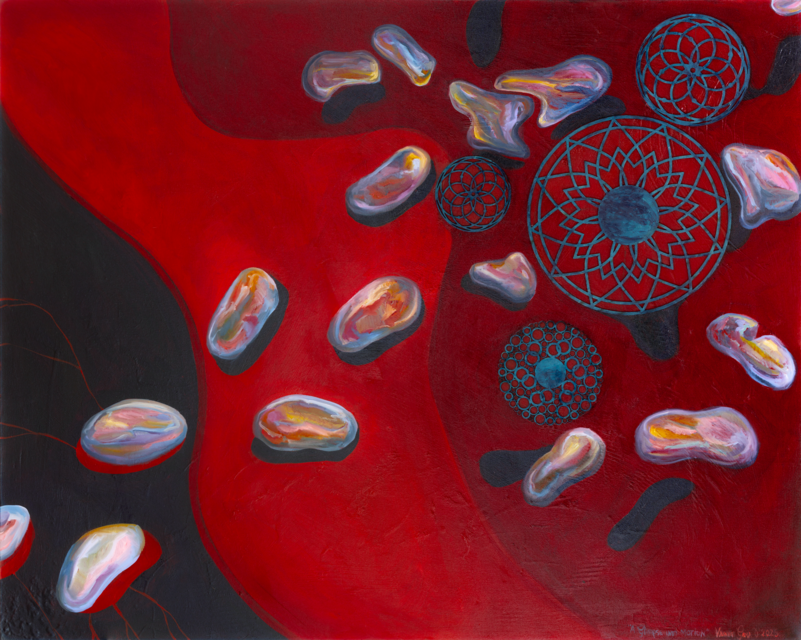
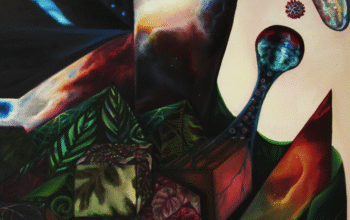
I am not going to share the entire experience of my fellowship at CEPID – Neuromat, because, in a certain way, it can be visited by you. On the Traço de Ciência blog, 27 articles (in Portuguese) were written and published, in addition to a scientific article that, at this moment, is under peer review, in Microscopic Art. Without a doubt, the most relevant was the series “Atrás do Tempo,” where this question of interdisciplinary art that I had already been, in an exploratory way, working with since 2019, could in fact be taken to a much more rigorous and at the same time expansive level, with four works based on scientific articles from the center’s research lines, from the use of equipment such as EEG (Electroencephalogram) and the Eye Tracker, to the theoretical dimension that supports the center’s experiments, such as research in neuromathematics on the statistical and stochastic dynamics of neurons.
There I was, reading about chaos theory one day and thinking about how to integrate concepts that I had to study into a canvas, and on the next day, accompanying experiments at the center. The center is responsible for research on Parkinson’s, having a direct social and scientific impact on studies of the diagnosis of degenerative diseases and their scientific communication. Each work is, following Neuromat’s principles, available for public visitation and under the public domain of the IME Library – Institute of Mathematics and Statistics of the University of São Paulo.
Below I leave all the articles I wrote on Traço de Ciência.
- 02/05/2025 – Do zootropio à vídeos de vida microscópica, aos impulsos elétricos do cérebro: Ah! A apresentação das imagens e seus contextos…
- 09/05/2025 – Natureza e Tecnologia : um típico dia ciborgue em 2025
- 16 /05/2025 – A Natureza do Cérebro e a Tecnologia dos Vídeos Curtos: uma noite de dopamina em 2025
- 23/05/2025 – Ilustração Científica : História ambiental como resiliência tange também a imagem (1/2)
- 30/05/2025 – Ilustração Científica : Mídias tradicionais e Novas mídias na prática e na teoria (2/2)
- 06/06/2025 – Imagens do Cérebro: Onde as interpretações são inovações de fora para dentro (Introdução)
- 13/06/2025 – Ilustração da Máquina? Inorganicidade e Organicidade.
- 20/06/2025- Arte Microscópica: Tecnologia, Neurociência e imagem artística.
- 28/06/2025 – O jovem cientista Alan Turing: inventor dos sonhos da computação.
- 04/07/2025 – Antes da persistência da retina: Objetos Ópticos, Cinema e Vídeos…Introdução aos Contextos Perceptivos | (1/2)
- 11/07/2025 – (3/4?) 3/4?
- 18/07/2025 – Após a Persistência da retina e Persistências Contemporâneas? | Percepção Sensível e suas Tecnologias (2/3) https://difusaoneuromat.wordpress.com/2025/07/18/apos-a-persistencia-da-retina-objetos-opticos-cinema-e-videos-e-persistencias-contemporaneas-percepcao-sensivel-e-suas-tecnologias-2-3/
- 25/07/2025 – Artistas do CEPID Neuromat: Sara Müller – Traço de Ciência
- 01/08/2025 – ”A Glimpse into Motion” | Obra de arte da série ”Atrás do Tempo” (2025) – Traço de Ciência
- 08/08/2025 – ”Building Neural Dialogues” | Obra de arte da série ”Atrás do Tempo” (2025) – Traço de Ciência
- 15/08/2025 – ‘’Hidden Patterns of Memory’’ Obra de arte da série ‘’Atrás do Tempo’’ (2025) https://difusaoneuromat.wordpress.com/2025/08/15/hidden-patterns-of-memory-obra-de-arte-da-serie-atras-do-tempo-2025/
- 22/08/2025 – O limite da retina: Os objetos ópticos e instrumentos de visualização das ciências | Percepção Sensível e suas Tecnologias (3/3) https://difusaoneuromat.wordpress.com/2025/08/22/o-limite-da-retina-os-objetos-opticos-e-instrumentos-de-visualizacao-das-ciencias-percepcao-sensivel-e-suas-tecnologias-3-3/
- 29/08/2025 – Doação de Obras Biblioteca IME e Divulgaçãohttps://difusaoneuromat.wordpress.com/2025/08/29/serie-atras-do-tempo-doada-para-a-biblioteca-do-instituto-de-matematica-e-estatistica-da-usp/
- 05/09/2025 – A Importância da subjetividade para a difusão científica: ”Escutar as Árvores” https://difusaoneuromat.wordpress.com/2025/09/05/a-importancia-da-subjetividade-para-a-difusao-cientifica-e-escutar-as-arvores/
- 12/09/2025 – Crise Tecnológica? Um contrato social (1/5) https://difusaoneuromat.wordpress.com/2025/09/12/crise-tecnologica-um-contrato-social-1-5/
- 19/09/2025 – Crise Tecnológica? Criação e Resolução sob pressão da Fênix (2/5) Crise Tecnológica? Criação e Resolução sob pressão da Fênix (2/5) – Traço de Ciência
- 26/09/2025 – Crise Tecnológica? Ética, Biotecnologias e Exploração Espacial (3/5) https://difusaoneuromat.wordpress.com/2025/09/26/crise-tecnologica-etica-bioengenharia-e-exploracao-espacial-3-5/
- 03/10/2025- Crise Tecnológica? Identidade e construção de autoimagem respiram o cultural hiperconsumismo (4/5) https://difusaoneuromat.wordpress.com/2025/10/10/crise-tecnologica-identidade-e-construcao-de-autoimagem-respiram-o-cultural-hiperconsumismo-4-5/
- 10/10/2025- Crise Tecnológica – Ecosofia dum Futuro Ancestral e uma máquina do Tempo (5/5) https://difusaoneuromat.wordpress.com/2025/10/17/crise-tecnologica-ecosofia-dum-futuro-ancestral-e-uma-maquina-do-tempo-5-5/
- 17/10/2025 –Timelapses – Revolta contra as Obsolescências Técnicas e os Fantasmas do Fim da Arte | ½ https://difusaoneuromat.wordpress.com/?p=12901
- 24/10/2025 – Timelapses – Inteligência Artificial On/Off e Radioatividade | 2/2 https://difusaoneuromat.wordpress.com/?p=12901
- 31/10/2025– O Boto do Rio Yangtze e o Boto do Rio Amazonas https://difusaoneuromat.wordpress.com/?p=12925
Aditionally, the works from the “Behind Time / Atrás do Tempo ” series also have their own articles, as well as a feature by the university. You can access them below as well.
- 11/07/2025 – (3/4?) 3/4?
- 01/08/2025 – ”A Glimpse into Motion” | Obra de arte da série ”Atrás do Tempo” (2025) – Traço de Ciência
- 08/08/2025 – ”Building Neural Dialogues” | Obra de arte da série ”Atrás do Tempo” (2025) – Traço de Ciência
- 15/08/2025 – ‘’Hidden Patterns of Memory’’ Obra de arte da série ‘’Atrás do Tempo’’ (2025) https://difusaoneuromat.wordpress.com/2025/08/15/hidden-patterns-of-memory-obra-de-arte-da-serie-atras-do-tempo-2025/
- 29/08/2025 – Doação de Obras Biblioteca IME e Divulgaçãohttps://difusaoneuromat.wordpress.com/2025/08/29/serie-atras-do-tempo-doada-para-a-biblioteca-do-instituto-de-matematica-e-estatistica-da-usp/
- Wikicommons access to the artworks in high definition: File:Hidden patterns of memory – series Behind (in search of) Time – Oil on Canvas, Vannie Gama, 2025. BJC III Fapesp – CEPID Neuromat – IME – USP.webp – Wikimedia Commons
Having worked during this half year at the center, with genuinely incredible researchers and people, made me see the potential of scientific communication in another way. It is totally possible to nurture an environment that puts public health first, without leaving aside scientific communication, interdisciplinary artistic creation, encouraging research that is diverse while still able to communicate at certain points, as in our textual productions – in addition to our productive and enjoyable in‑person meetings.
I thank FAPESP, CEPID – Neuromat, all my colleagues, and the IME‑USP Library for the “revolution” in thought that I experienced while developing interdisciplinary research with you, in a way that linked paint, neuroscience, and scientific communication, with social diversity and the welcoming of everyone there. There is also this: it is not every day that we, trans researchers, are so naturally welcomed, in a daily life where we are like everyone else – we deliver our results, solve technical and theoretical problems, listen to and participate in everyone’s research.
When the article is published, I will post an update on the website so you can access it. Following the center’s principles of open science, the journal chosen for publication is also open source.
See you next time, for the final parts of this retrospective.
Share this:

Would you like to receive the next post on your digital door?

_Time_-_Oil_on_Canvas,_Vannie_Gama,_2025._BJC_III_Fapesp_-_CEPID_Neuromat_-_IME_-_USP.webp)