By Vannie Gama.
Context
The first studio I ever visited belonged to a Brazilian artist living in Paris. At the time, I was accompanied by one of my professors (and mentor) from university, during my final year of the visual arts program. The atelier belonged to a friend of hers. He lived on the floor above, like every artist who can’t truly separate life from their own art. Curiously, what I remember most about his studio was the way he organized his adhesive tapes and rulers. He was an assemblage and three‑dimensionality artist in, so the way he stored those things was particularly ingenious. That was seven years ago, now in this month of October 2026.
Paris is a place full of studios and a very specific culture of residencies. Every time I go to the city of lights, I spend a large part of my time visiting ateliers — a kind of new tradition. However, I learned from older artists that a good studio is not the one with the best location in the city, but the one that emits its own atmosphere of creation. Monet, for example, lived in the same place as his studio during his entire life — and in his case it was even more enchanting, considering the immense garden he dedicated himself to ‘sculpting’ over decades in Giverny.
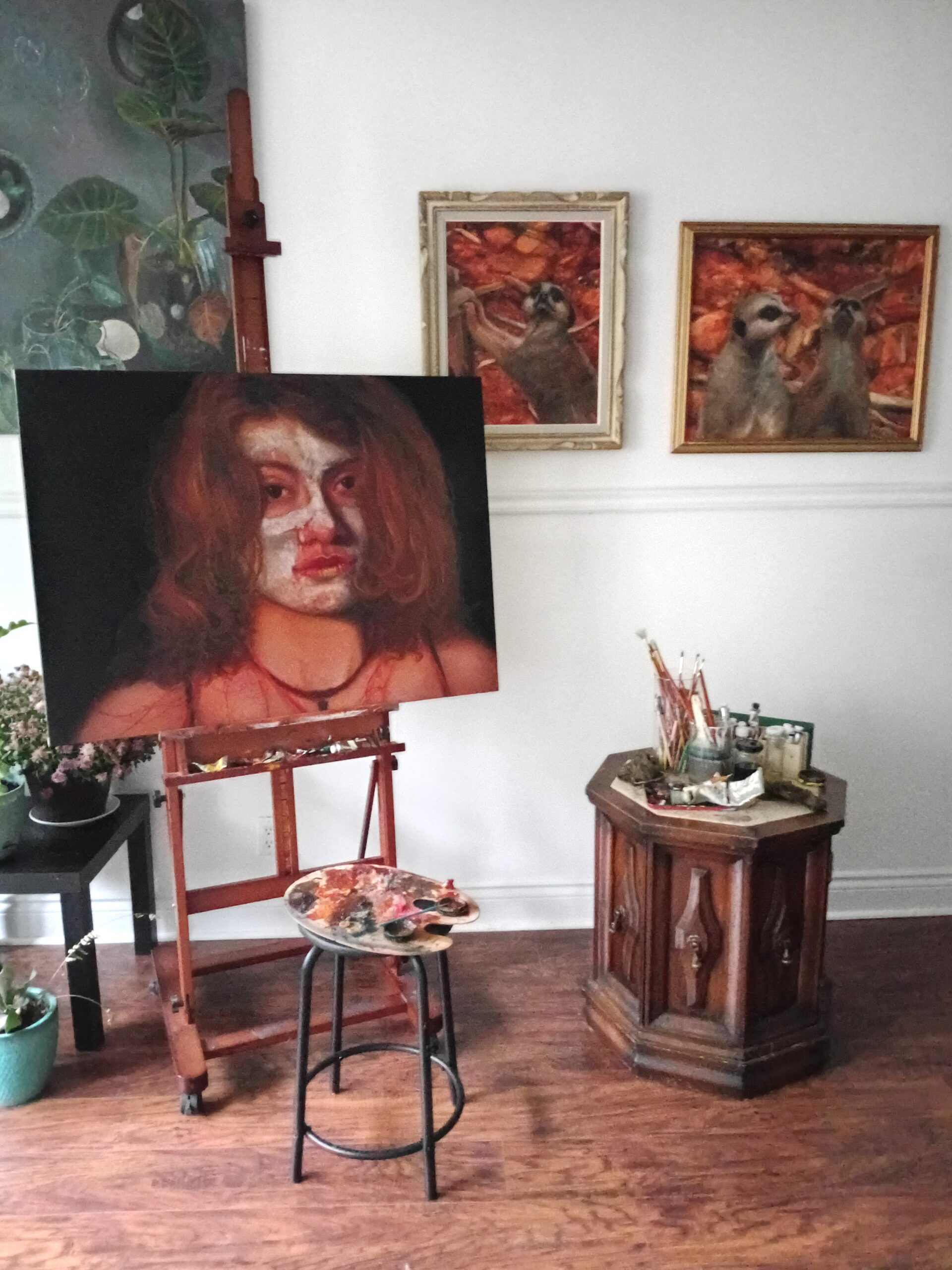
I open my own atelier in 2026 in Montréal for very specific activities: masterclasses, mentorship, and a cup of tea. I still don’t have a vast garden or a large space to create any kind of institute or cultural house properly, so I maintain a simple atelier integrated into life. Books everywhere blend with materials and ideas, especially in these years of the doctorate; my plant collection is the matter that surrounds the big windows of the studio, and my cat, Carina, is always sitting patiently in one of the studio chairs.
Masterclass and Mentorship: Numb Terms, Necessary Distinctions.
We are all tired of courses. ‘Courses’ are something that has been significantly diluted because of the online environment. Yet we also know that there are good courses and useless ones. Some people have told me that I could ‘just film and post’, but that would go against absolutely everything I was taught, everything my mentors and professors have passed on to me (and continue to pass on) throughout this decade of art and research. Nothing replaces the exchanges we have with our professors within the reality of practice. It is evident that a remote course also has great potential, as long as it is still structured within a method and a dynamic specific to that student, or to those students (small groups).
Here, one distinction is important: a masterclass is different from a course in the contemporary sense, because if we think of the period before ‘masterclasses’, we would be talking about intensive courses aimed at advancing a specific technique. Mentorship, however, is somewhat different, because it does not have such a determined structure as a masterclass; it is more diagnostic and even more focused on the background of the person receiving that mentorship.
I will share some context again. I began painting at nine years old. In 2007, when I turned ten, I signed my first canvas. My first mentor and teacher was Mr. Dirceu, a painter in his mid‑forties or fifties, in the countryside of Rio Grande do Sul, in Horizontina (the city where the model Gisele Bündchen was born, incidentally). We painted in a group, and I was the only student under twenty. It was there that I learned my first techniques. Dirceu taught me how to relate to the canvas, to explore space and the limits of paint, to organize thought and action prior to any classical techniques.
Dirceu gave me the tools for study, and from there I experimented until entering university, where I received an honorable mention in Visual Arts (UNESP). At university, I learned the difference between a course and a mentorship. I had great mentors: art historians and artists-professors. I met older artists who were also mentors, sharing what comes after technique: how the art world works, what truly must be questioned when you decide to become an artist; the philosophies, the dilemmas, the course corrections, the patience and the illusions. It was my mentors who shaped me, in the sense that they were the people who motivated me, for example, not to give up research nor artistic practice, and who showed me that it was entirely possible to become an art theorist and a visual artist at the same time — though, as they said, ‘with twice the work’. I literally learned about all centuries of art history in detail, including their techniques, their gossip, misconceptions, art market web, and legacy throughout time. I am not only a painter, but a researcher, a performer, a writer, a contemporary in mind and media, and mostly, an interdisciplinary artist interested in the depths and the flights reachable throughout one’s art.
I began teaching painting while still in university, also becoming an assistant to professors. Certainly, at twenty‑one or twenty‑two, I did not yet have the best background for mentorship, for example. Today, after residencies, books, biennials, and nearly a full turn around the world, I have the serenity and pleasure of opening my atelier for advanced techniques (masterclasses), always accompanied by mentorship — after all, one thing is the teaching of a technique, a principle, the application of a method, and another thing entirely is the advice, observations, and conversations of mentorship.
My masterclasses are preferably in person (either with you coming to my atelier, or with me going to your home), but also remote. For more information and registration, access the form (original in French). Formulaire d’inscription – Atelier d’art de Vannie Gama – Google Formulaires , you can also read down below a more specific frame on methodology and materials. If you still have doubts, please feel free to contact me or my assistant via email: co*****@********ma.art .
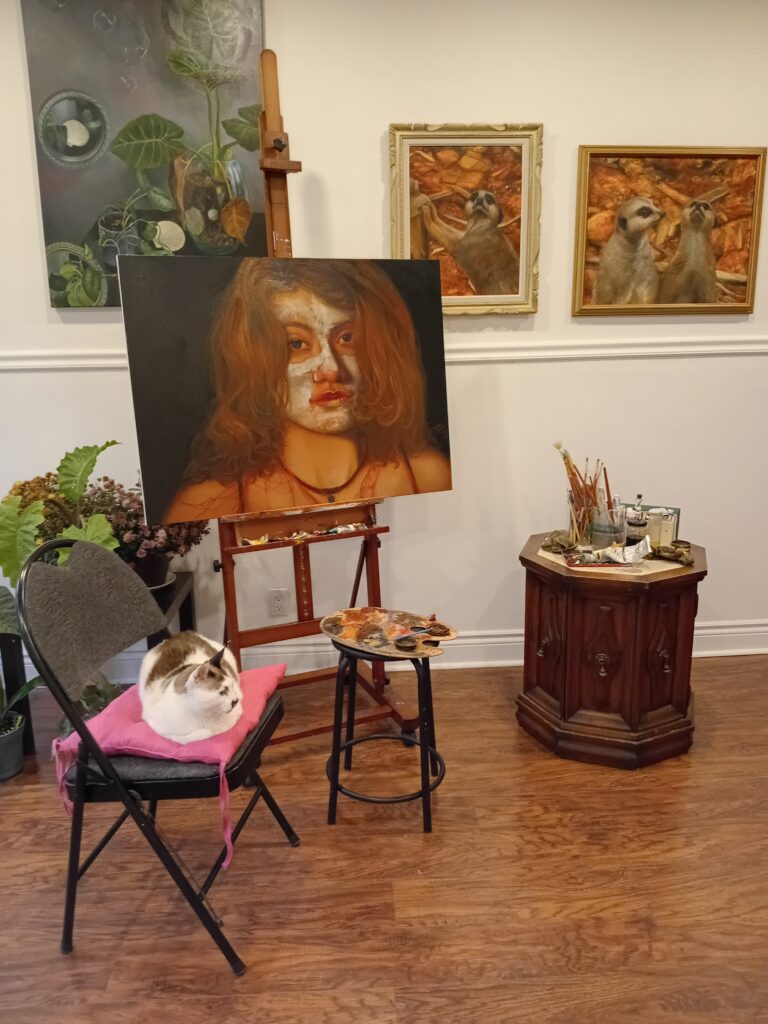
2026 view of my studio with the pieces ”Partially Rooted”, ”Hm?”, ”Hm!” and ”Amber Lyric”, all from 2026.
Regarding the ‘cup of tea’, it comes from the fact that I love welcoming people — close friends, artists and researchers, travelers, and curious minds — into my atelier. Since I was nineteen, I’ve had the habit of hosting afternoon teas at home, sometimes stretching them into evening glasses and warm lights. Talking about the world is essential in times of crisis, and art is never exempt from its social role — a role carried out by us, ordinary people.
Moreover, in times of social isolation and this dependence we’ve developed on the online world, I believe it is especially important to spend time with natural time unfolding right in front of our eyes. In the future, I intend to transform part of these ‘cup of tea’ moments into residencies for other artists and collectives.
Until then (2029), if you would simply like to spend some time in an art atelier located in Montréal and refresh your ideas, my open studio works with a bit of communication, also through e-mail as well: co*****@********ma.art for available hours. Maximum of three people per cup of tea.
Returning to Methods and Materials: Didactic Philosophy
For those of you who would like to know more about the methods and materials of the masterclasses, I will first share my didactic philosophy. Although I have had fantastic mentors and professors, I have also had negative experiences (and still do, at times) with certain ways of teaching. Beyond this artistic dimension, I am also a university assistant in other humanities subjects, and I have been a mentor to undergraduate students. This proximity to students also teaches me to combine what was important to me as a student with what tends to be important for others.
My didactic philosophy is to show possibilities, to offer experimentation, and—after experimentation—to share technical rigor, prioritizing the understanding of one’s own creative process and the procedural adaptation of each medium. In other words, my priority is to encourage you to unfold your own language, while reminding you that boats need sails to travel far, and sails must be controlled according to time—which, in our case, is the time of the medium. Every project objective must pass through a procedural structure, and while the project itself is the pure fruit of each student’s creativity, the procedural structure is a path that a good mentor helps us organize and persuade, helping us understand certain stages, even if the goal is to revolutionize them or remove them. One must learn in order to deconstruct.
The duration of masterclasses and mentorships ranges between one hour, one and a half hours, and two hours. If you open the form above, you will see that I created a selection of possibilities: classical and contemporary figurative oil painting, contemporary semi‑figurative and abstract painting, watercolor and ink, art theories and materials from the 15th to the 21st century, creative processes and career organization, pigments and advanced oil painting, light techniques and color control, and scientific illustration. We will organize methods and materials according to each of these major tracks. I attached some visual references after the tracks.
Track — Masterclass in Classical and Contemporary Figurative Oil Painting
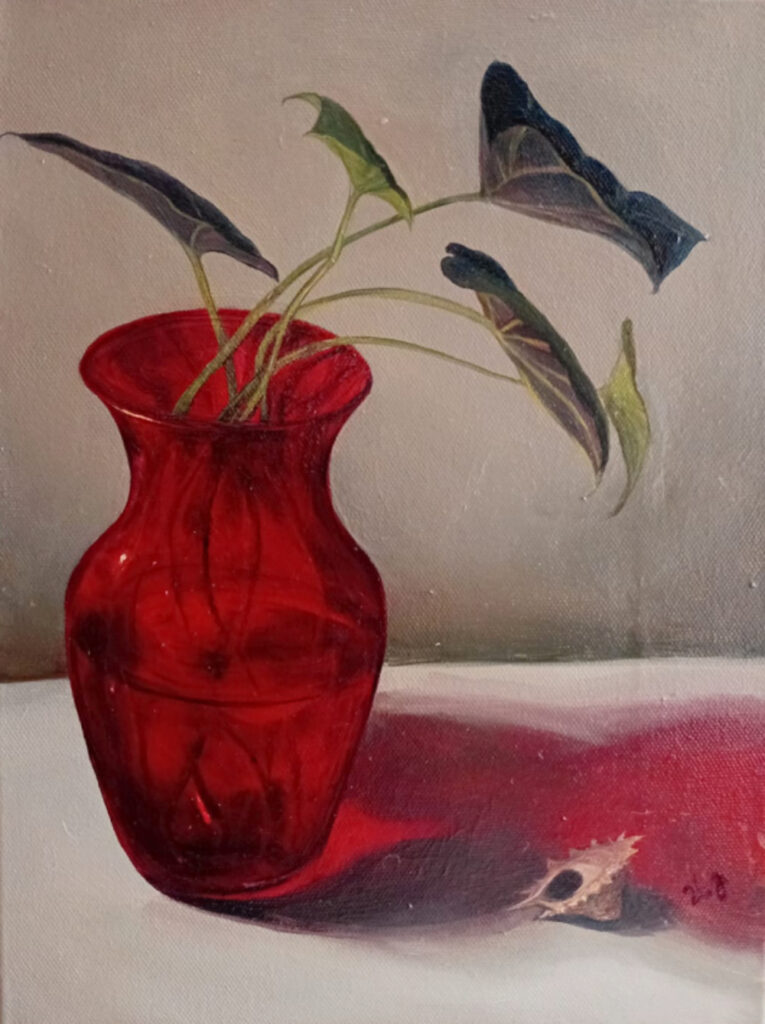
This track is aimed at those who are interested in the figure closest to reality, whether in form or color. Here, creativity is conceptual and compositional, not necessarily in the image itself—classical techniques and the laws of layered oil painting, pigment types and order, light and shadow are just some of the methods, along with my personal methods for understanding weight and texture of real objects through observation and diagnosis.
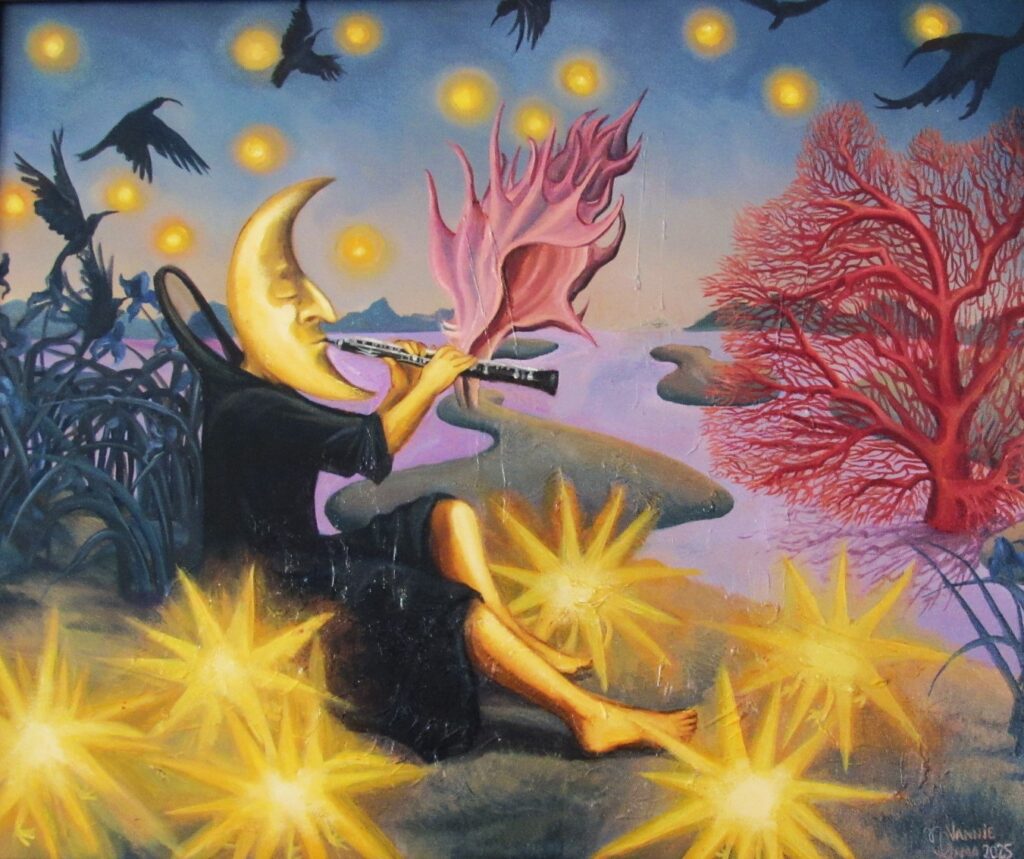
Classical and contemporary figurative painting fits the works shown from the atelier a few topics above. Works such as Amber Lyric, the meerkats hm? and hm! are contemporary figurative paintings, while the red vase below is a classical figurative painting.
Track — Contemporary Semi‑Figurative and Abstract Painting
This track is aimed at those who already have knowledge of classical painting or who would like to explore expressiveness and non‑figurative two‑dimensional languages directly, whether in a semi‑figurative spectrum or in full abstraction. For this, we will work with theorists such as Kandinsky, understand the student’s language and visual objectives through a primary conceptual proposal, adapting classical techniques and refining projects in intensity and cohesion with oil paint*. Here, we may explore other materials on canvas, with the exception of acrylic paint (I do not teach masterclasses or mentorships in acrylic).
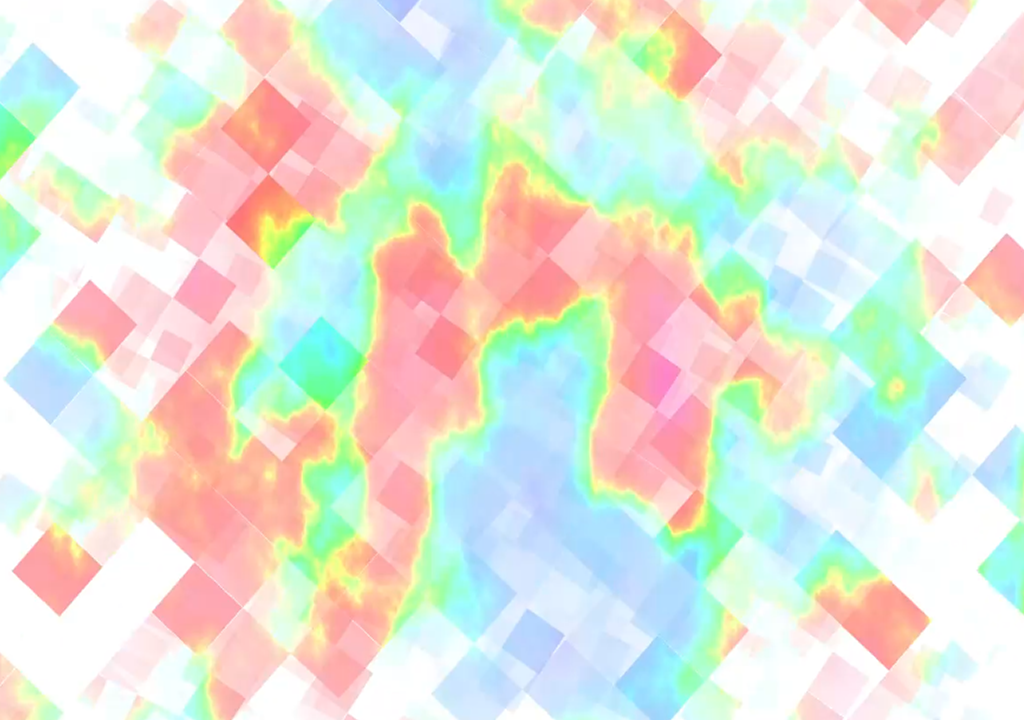
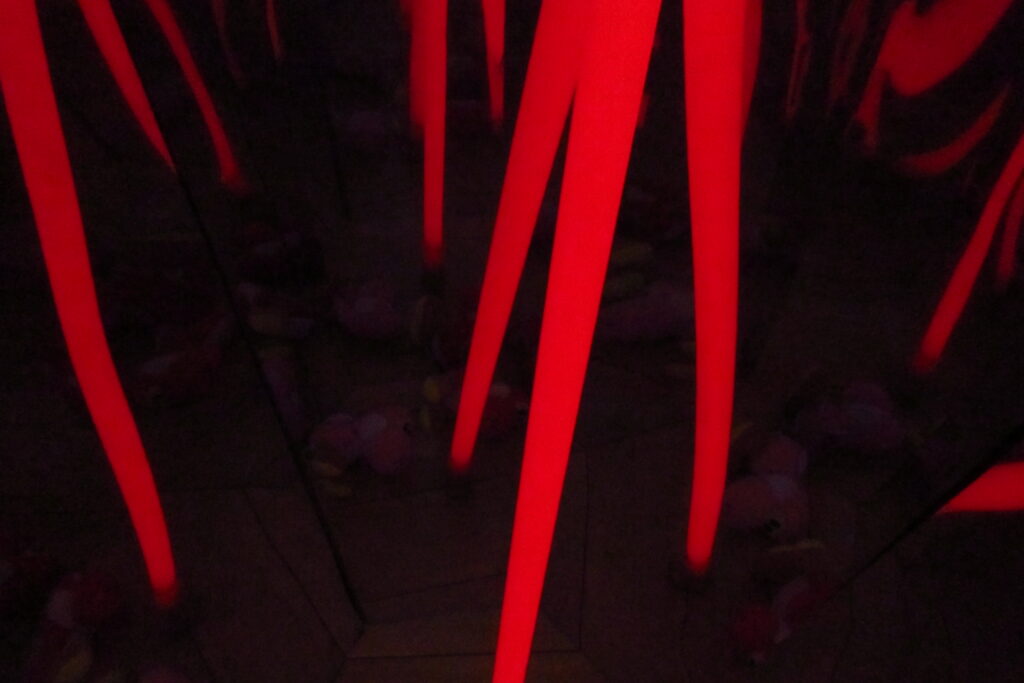
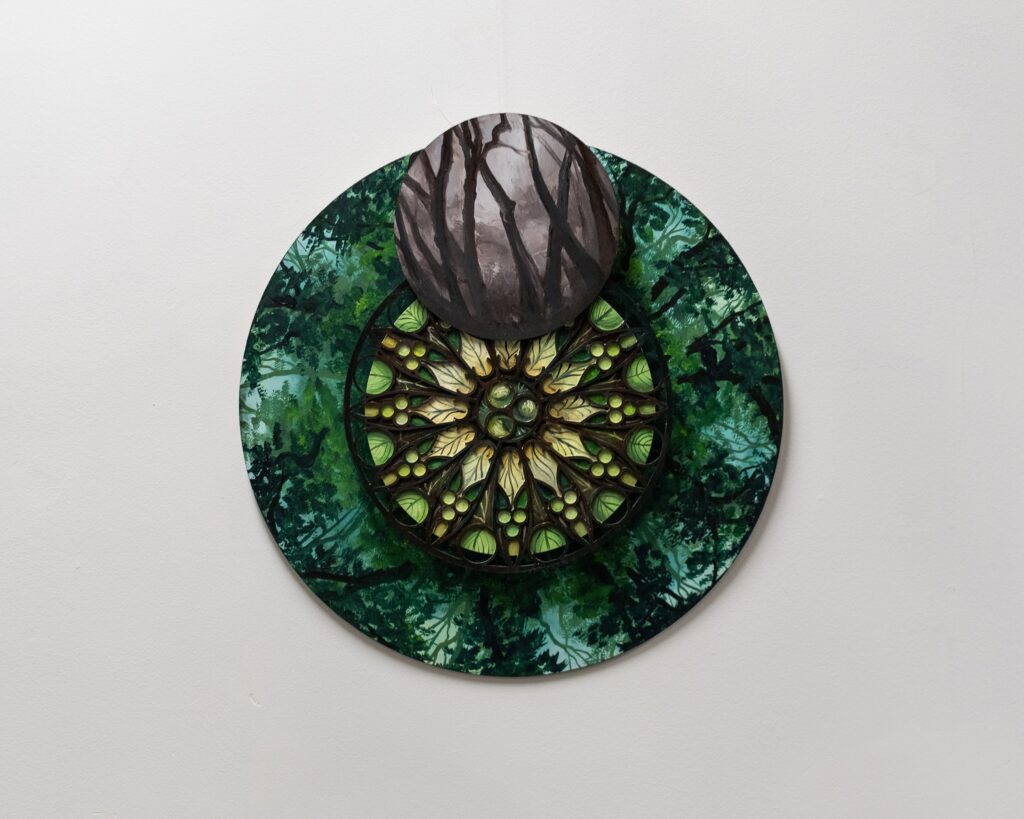
This track corresponds to works such as Spectrum Carbon n.1 and Cadence of Freedom (images 5 and 3 below), where the figure is clearly not anchored in realistic representation and may vary from a fantastical graphic to what would be visually considered abstract, although conceptually anchored in reality or in proposals, ideas, and manifestos in dialogue with the material world.
Track — Masterclass in Watercolor and Ink
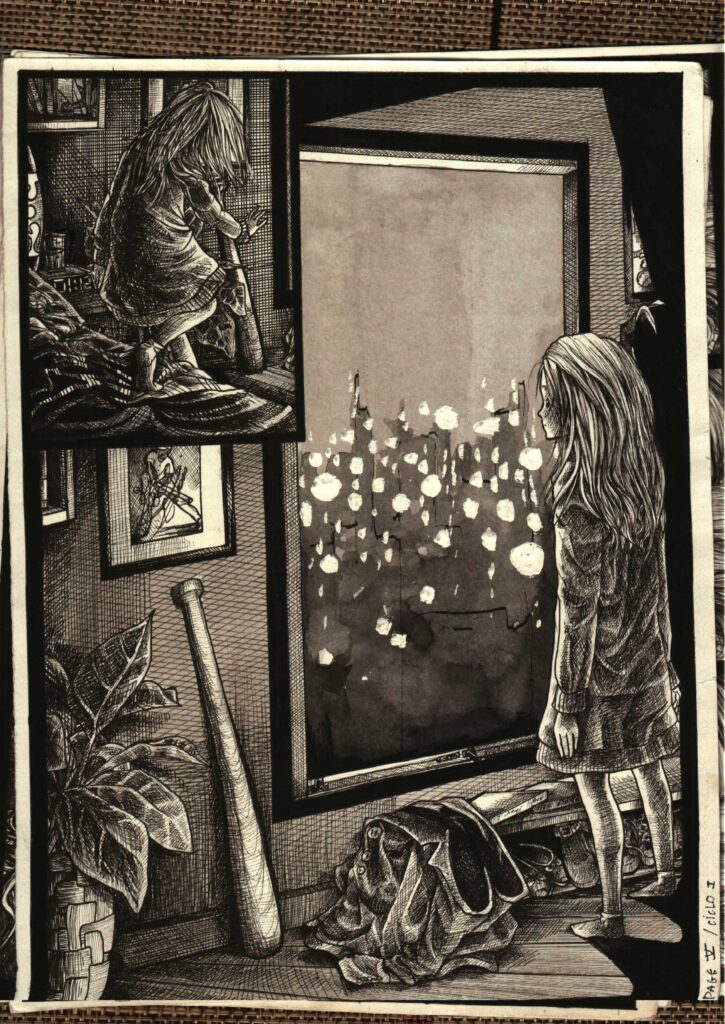
This track is for those who prefer techniques on paper, whether for the expressive value of the material or for the need to focus on drawing and not only painting. This track values the study of drawing with classical techniques and exercises in observation, extension and retention of figure, outdoor experiments, and surface research. Visual examples include image seven, with a graphic‑novel illustration board made in ink. Here, the watercolor track ranges from figurative to abstract, depending on the student’s interest and language.
Track — Masterclass in Art Theories and Materials from the 16th to the 21st Century
This is a theoretical masterclass aimed at students and artists who wish to deepen their knowledge in theory, history, and materials throughout art history. This track is also in person, though it may be semi‑presential, and includes museum visits, observation of real works and historical/technical diagnosis, visits to art stores, collections, and exhibitions. It is aimed at students considering restoration and curatorship as well, through an applicable theoretical lens focused on three key centuries and secondary centuries, respectively: the 15th, 19th, and 20th centuries, with revisitations to the 16th, 17th, 18th, and 21st.
Track — Masterclass in Pigments and Advanced Oil Painting
This track is for advanced artists and students interested in making their own pigments or understanding how pigments work, from the chemical level to the historical level, and their application on canvas. The use of pigments is radically different from the use of tube paints; it requires an interdisciplinary technical level and more execution time, but it also achieves more authentic visual results and a deeper connection with one’s own language. Here, techniques from the 14th, 15th, and 21st centuries are explored. We enter Renaissance and Dutch painting theories, as well as new materials. Toxicity and safety lessons are also provided.
Track — Masterclass in Light Techniques and Color Control
Similar to the pigments and advanced oil painting track, light techniques and color control is the advanced version using traditional tube paints for those who already have some painting experience and would like to refine color intensity, chiaroscuro techniques, or depth. It is a course focused on understanding composition, organization, angles, and painting planes.
Track — Masterclass and Mentorship in Creative Processes and Career Organization
Like the theoretical track in theory, technique, and art history, the masterclass in creative processes and career organization is usually a track in which one regular month is enough to advance career planning and organization, unlike the other tracks that extend from one month to a full year. This track is designed for emerging artists with less than five years of career or recent graduates who would like guidance in understanding their creative style and the possible horizons aligned with their personality, language, geography, and goals. This track is not a masterclass, because it depends entirely on an environmental diagnosis of the artist. It is also not a consultancy—I will not teach you how to sell your work or which artwork will be most successful. We will understand where it makes the most sense to share your work, understand your identity as an artist, and the do’s and don’ts of the art world (vanity fairs, vanity residencies vs. legitimate spaces, social media pros and cons, etc.). It is also ideal for those who feel crystallized in a technique and would like to reopen their creative processes.
Track — Scientific Illustration
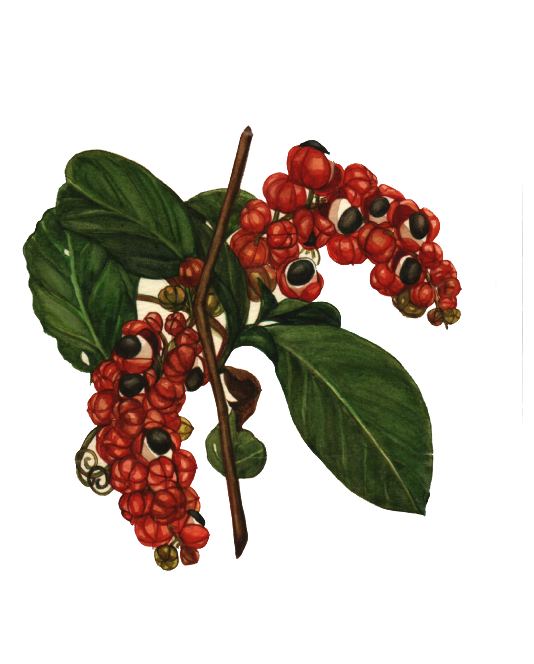
Finally, the scientific illustration track is aimed at those who would like to learn classical scientific illustration techniques (watercolor and other materials on paper), especially for fauna and flora. This is not a track in medical scientific illustration or technical drawing, as I do not have training in health or engineering to teach such a course. This track, like the others, also includes outdoor dimensions, observation of plants, birds, insects, and other animals, in an ethical and sustainable way. Ideal for those who already draw, but also open from beginner to advanced.
General Note
Each track has a fixed number of modules per discipline, except for the mentorship in creative processes, which has irregular modules. All tracks, without exception, include at least one outdoor module—generally a museum visit for practical observation and application of concepts (paid by the instructor). All technical tracks include at least one module in an art materials store, while theory and pigment modules include four modules in specialized stores. The mandatory class in materials stores is designed to avoid unnecessary or expensive purchases, serving as a first contact with the myths of the art world: dismantling the idea that expensive materials are unfailingly needed; understanding which materials we buy according to our technical level is essential in every technique. All modules require students to have a notebook for notes; aside from museum days, the rest of the materials are the responsibility of the students, who will be guided in terms of cost‑benefit and realistic, basic, and when possible, accessible purchases. Outside advanced tracks, there is no need to purchase books or catalogs. Remote classes include an online document with the organization of each lesson’s content via a shareable link. All shared material is freely accessible, with modules available as the masterclasses progress.
Reality in the Arts and Research
Finally, something (else) interesting—whether for masterclasses, mentorships, or simply a cup of tea—is the experience of the now. You will actually see my own series, upcoming exhibitions, book and article references, residency applications and works-in-progress, all with a kind of everyday naturalness; it is not (only) about seeing what has already happened, but what we are actually creating (and complaining about). In the atelier, right beside your canvas, are my own works‑in‑progress, and through that, we can also share new insights. For beginner and intermediate students, this is also an environment where you can see the day‑to‑day, the practice of concepts, and the reality of a (relatively) young contemporary artist and researcher. There will be no space for romanticizing the profession; however, there will be plenty of space to presently live the experience of art (which is, by excellence, a collective one).
Au plaisir,
V.A.P.G.
